Category Archives: Uncategorized

Data Stories goes to Belfast for CIG 2025

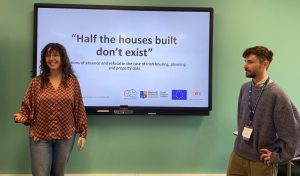
Earlier this month Samuel Mutter and Danielle Hynes attended the Conference of Irish Geographers 2025, held at Queens University over three exceptionally sunny days. Danielle and Sam presented in two sessions: ‘Creative Methodologies’ and ‘Critical Geographies of Housing’.

[Image: The Elmwood Building, QUB, where the conference was held.]
In Creative Methodologies, Danielle and Sam discussed two aspects of their current work, focusing on their ongoing collaboration with artist Mel Galley on the theme of ‘data narratives’ and nascent work around photographing planning site notices around Ireland. In a presentation titled ‘Telling Data Otherwise: Creating Housing Data Stories through Researcher-Artist Collaboration in Dublin, Ireland’, they reflected on the collaborative process with Mel, tracing the work of artist and researchers to find ways of unsettling, countering or responding to mainstream data narratives of housing and planning through practices such as grid-based story writing. Meanwhile, reflections on site notice photography raised the potential for such approaches to foreground the emplaced and material qualities of data in the built environment.

[Image: Danielle and Sam presenting their work.]
Two other excellent presentations were delivered in this session. The first was from Gerry Kearns, Isabella Oberlander, Fearghus Ó Conchúir and Karen Till who discussed dance as a form of knowledge and the possibilities of tearmann aiteach / queer sanctuary. The second came from Ruodi Yang, who is exploring public space under neoliberalism through the lens of street performance.  

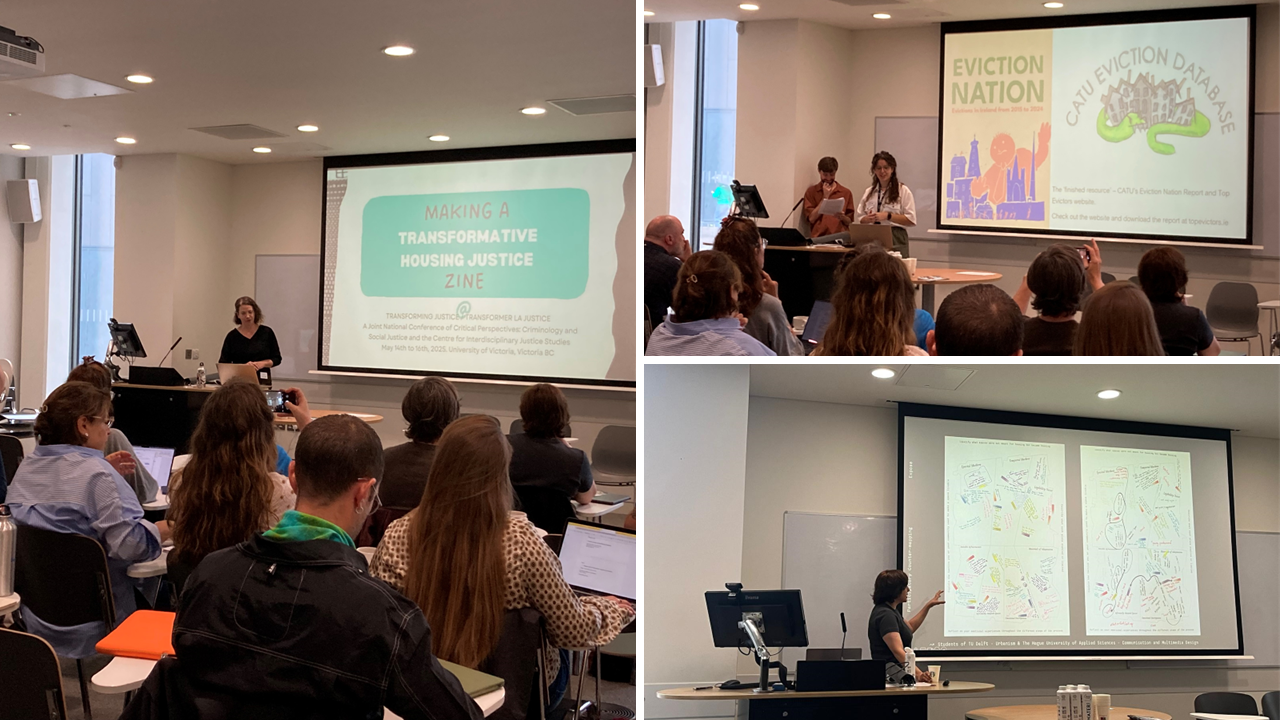
In the Critical Geographies of Housing session Sam presented findings from CATU’s Eviction Nation report, in place of Fiadh Tubridy who was unable to attend. Danielle presented on work undertaken during her PhD, examining the shift from government managed public housing to NGO-owned and managed community housing. This presentation was in conversation with Maedhbh Nic Lochlainn’s work, who also presented in this session, examining the similar shift from social housing delivered by Local Authorities in Ireland to the increasing growth of the AHB sector.

[Image: Sam presents Eviction Nation.]
On the final day, attendees were invited on one of two field trips. Danielle attended a bus tour of Belfast, led by geologist and geophysicist Alastair Ruffell. Attendees visited various sites around Belfast and heard a little about the history of the city. Visiting the peace wall, two graveyards, and the new Grand Central Station (to drop off everyone heading home), Alastair told us some of the history of the city and his part in it as a forensic geologist.

We’d like to thank the organisers for such a wonderful and well run conference, and to all those who attended sessions where we presented and asked such engaged questions.

Want to share this? (click + below for more options)

The Community Action Archives Event in Dublin

On Monday the 5th of May, postdoctoral researcher on the Data Stories project Sam Mutter participated in a day of events on Community Action Archiving at the Usher Street Community Centre, Dublin. 

The event was hosted by Tom O’Dea (NCAD) in collaboration with the Liberties Community Development Project and the Community Action Tenants Union (CATU), of which Sam is a member. The day was attended by a mixture of artists, community activists (including those from CATU) and NCAD students on the Masters in Art and Social Action.

The Community Action Archives Event Poster
[Image: The Community Action Archives Event Poster]
Led by fellow members of the CATU archiving group Tommy Gavin and Jazz Burns, Sam helped facilitate a workshop practicing cataloguing for the CATU digital archive, using sample materials produced by CATU and other related Irish housing activist groups. Activities involved using a draft intake form developed by the archiving group to catalogue different types of record, from campaign leaflets and social media content, to documents from CATU’s Ard Fheis (Annual General Meetings).    

In a pragmatic sense, the activity provided feedback to the archiving group on how the intake form and associated processes could be clarified or improved with a view to opening up this process to other members via their local branches. However, it simultaneously prompted discussions around the politics of sensitivity and redaction (especially in the current global political climate), and the importance of cataloguing in this context being a collective endeavour which wherever possible involves the creators, users and/or subjects of the data in question.

Sample CATU materials used for the cataloguing exercise.
[Image: Sample CATU materials used for the cataloguing exercise.]
The CATU workshop joined a selection of other interesting events throughout the day. This included a talk from Josh MacPhee of Interference Archive, based in New York, a brainstorming session around the potential for a physical housing action archive to be established in Dublin, and artistic works from NCAD students made using and in response to materials from the South Inner City Community Development Association (SICCDA) archive. 

Common themes across these sessions included the challenge of creating archives as an accessible space of lively engagement through which communities would feel an attachment to memories and histories, and be inspired to collective action – as opposed to more traditional conceptions of archives as dusty rooms full of carefully indexed boxes. This in turn sparked conversations around the balance to be struck between engagement and preservation, and the question of how archives might be meaningful and useful at a time when community and cultural spaces are frequently fighting against threats of removal in favour of more financially valuable land-uses.   

These discussions will help to shape the CATU archiving group going forward, as well as feeding into the broader findings of the Data Stories project. 

Want to share this? (click + below for more options)

Exploring European Data Stories: a field visit to Luxembourg

[Image: European district, Kirchberg plateau, Luxembourg by Juliette Davret]
Since January, our project has entered a new phase, launching a fresh series of case studies. While most of these are based in Ireland, we’ve broadened our scope to examine data practices at the European level. Given that Ireland must comply with EU data collection standards, we wanted to explore how European harmonisation shapes data production in Ireland, how data flows across borders, and the political and critical issues surrounding data practices. 

To investigate these questions, Juliette Davret travelled to Luxembourg in late April to meet with representatives from Eurostat and ESPON. At Eurostat, she met with the team responsible for short-term business statistics, and at ESPON, she connected with the team working on the Housing4All project. 

Before these meetings, she also spoke with representatives from Ireland’s Central Statistics Office (CSO). These initial conversations helped her understand how Irish statisticians prepare and submit data to Eurostat and highlighted potential areas of friction or challenge in meeting EU requirements. These insights proved valuable in framing the discussions in Luxembourg.

[Image: European district, Kirchberg plateau, Luxembourg by Juliette Davret]

Meeting with Eurostat representatives shed light on the complexities of data processing and standardisation across EU member states. They discussed the challenges of aligning timelines, addressing national data specificities, and creating entirely new datasets. These obstacles reflect broader tensions between Eurostat’s centralised data strategy and the diverse realities of data production in different countries, in line with what we have observed within Ireland’s own data ecosystem. 

At ESPON, the focus shifted to the topic of housing affordability and the difficulties of developing coherent data narratives at the European scale. Juliette met with both a project manager and a data manager, which offered complementary perspectives. A key challenge discussed was the lack of harmonised datasets, particularly concerning issues like housing vacancies and income. These data gaps make comparisons more difficult and challenge the development of evidence-based policies. The urgency of improving housing data was a recurring theme, especially given the strong role that data-driven narratives play in planning and housing policy across Europe.

[Image: European district, Kirchberg plateau, Luxembourg by Juliette Davret]
This field visit deepened our understanding of the broader European data landscape and how national and EU-level priorities overlap. It also emphasised the importance – and the difficulty – of building comprehensive, harmonised datasets to support effective and equitable policymaking.

Want to share this? (click + below for more options)

AAG Conference Recap: Sessions, walking tour and print making workshop

In the last week of March, Rob, Juliette and Carla’s schedules were packed full with a week-long attendance at the American Association of Geographers (AAG) Annual Meeting, held in Detroit, Michigan. This was the first AAG for Juliette, and a return after many years’ absence for Carla and Rob. It must be said that the sessions certainly did not disappoint. The week was packed with sessions organised by the team and papers presented by them, but we also co-organised a tour of Detroit and a print-making workshop. Below we highlight some of the key moments from the conference.

Data, Housing and Planning I & II 

Prof. Rob Kitchin Presenting at the AAG 2025

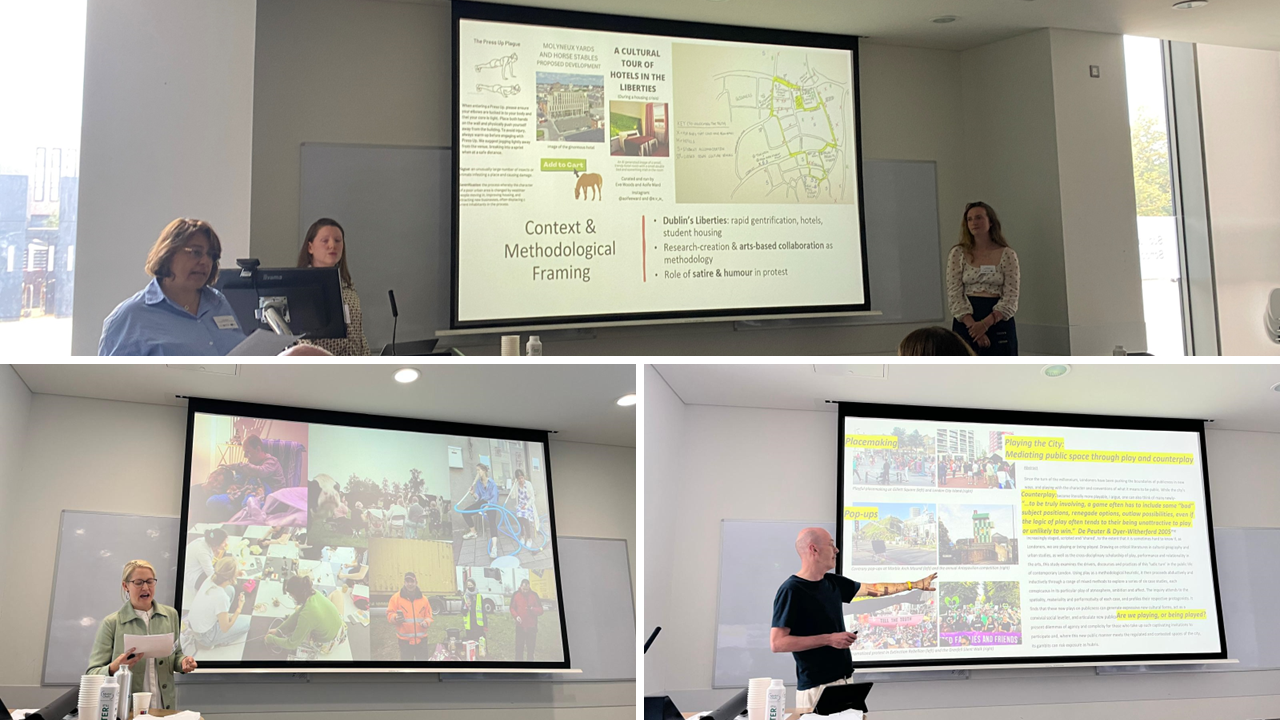
Despite flying all Sunday and feeling jet lagged, the Data Stories team, along with co-organiser Dr. Taylor Shelton, had the (mis)fortune of having their first back-to-back sessions slotted for Monday, the very first day of the conference, at 8.30 am. A total of 8 papers were presented on the themes of data debates, deriving sentiment from housing on data, data narratives and the politics and complications of aggregating housing data. Rob Kitchin presented work from phase 1 of the project in a paper titled, Data debates in housing and planning: The data politics of facts and counter-facts. Overall, the papers presented in this session were excellent. If all goes as planned, a selection of these papers will become part of a special issue in a housing journal. We will update the blog with details when that happens. 

Theoretical Perspectives on Research Creation in Place and the Built Environment I & II 

Carla Kayanan presenting at AAG 2025

The second organised session was also held bright and early at 8.30 on Wednesday. Two back-to-back sessions brought together researchers and artists working at the intersection where social science methods and arts-based methods intersect. A total of 9 presenters used wide-ranging case studies (green and blue environments, transportation, disability, war, data dashboards) as well as a series of mediums (comics, workshops, storytelling, archiveology, sculpture, visual storytelling, photographs) to theorise research creation and the co-creation of knowledge. Carla Kayanan opened up the session with a paper titled, Exploring the synergy between artistic practices and academia in shaping the built environment towards research-creation methods. This paper builds on previous work on research creation but draws from longer engagement with the first set of artists in residence. 

Juliette Davret presenting at AAG 2025

The final paper-related event occurred on Thursday with Juliette Davret presenting the paper Rethinking datafied movements: A critical comparison of direct action and lobbying as data activism in an urban context. This paper was accepted in Dr. Eugene McCann and Dr. Magie Ramirez’s pre-organised session, Futures of organizing and the urban: Confronting crisis in theory and practice. 

Exploring beyond the conference 

Outside of Huntington Place’s walls, the convention centre that housed the AAG, the Data Stories team members engaged in events that gave them the opportunity to experience Detroit’s built environment and its artistic community. On Thursday afternoon, Detroit scholar and historian, Dr. Patrick Cooper-McCann, took a group of Irish Geographers on a walking tour of downtown Detroit. 

Walking Tour of Detroit at the AAG 2025

The walk consisted mostly of discussions outside of buildings along Woodward, however we did enter the Guardian building and the Whitney hotel. 

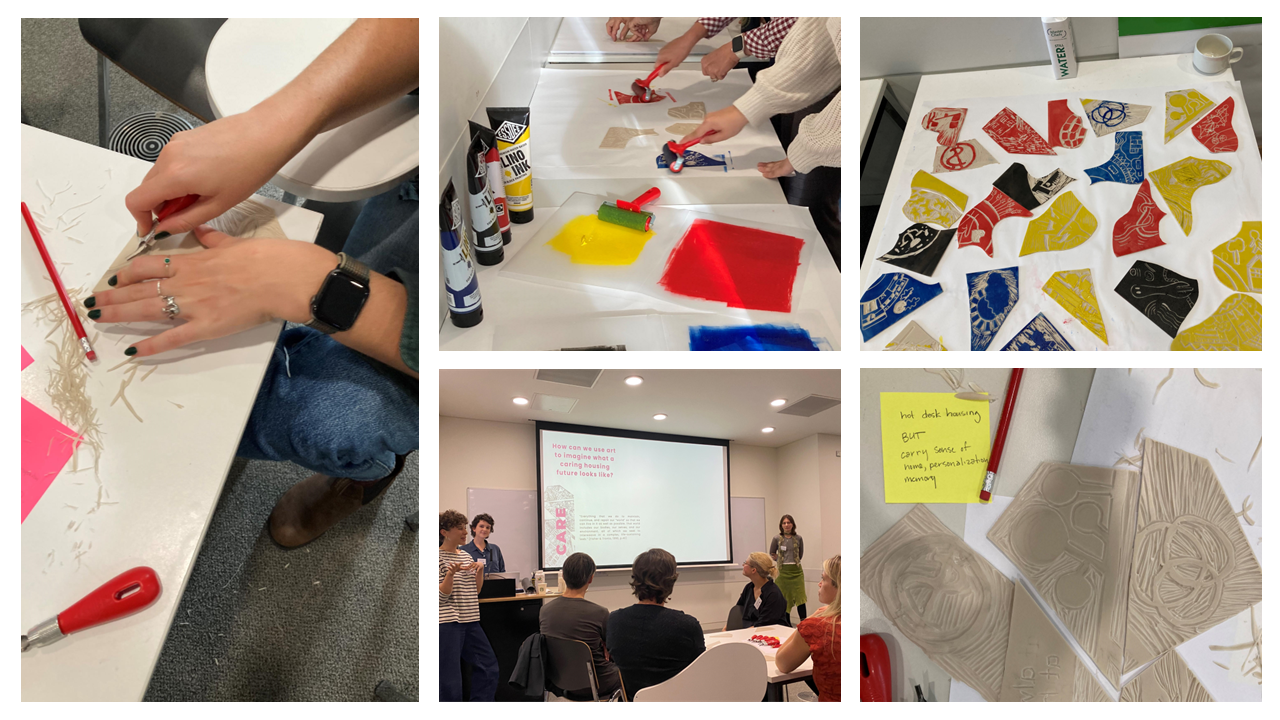
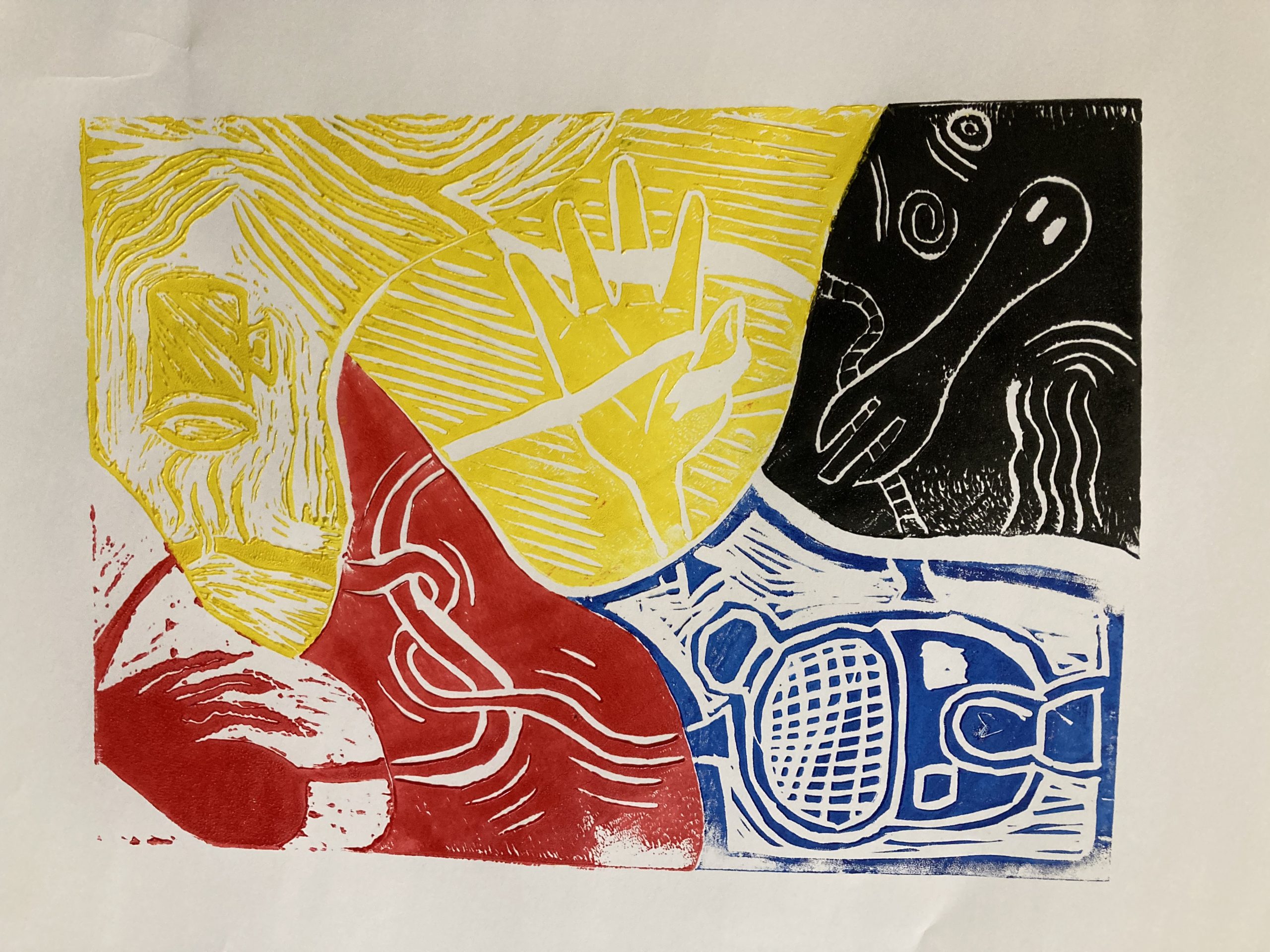
Finally, on the last day of the conference, Data Stories team members tagged along with Australian Geographers to attend a workshop by visual artist and printer Wendy Murray hosted in the workshop of Amos Paul Kennedy Jr. Wendy kindly took a morning to share her love of printing with the group. As part of the event, Dr. Kurt Iveson lead us on a walk of Wendy’s Detroit neighbourhood while the group, per Wendy’s request, focused on emergent feelings from the walk. These sentiments were then used to co-create a series of prints that Wendy then gifted to us. Additionally, though absent on the day, Amos had generously prepared a series of prints to present to our group. We cannot encourage you enough to purchase Amos’s beautiful and recently released book, Citizen Printer, and to read more about him and his work in this 2024 article by Charlotte Beach. 

Want to share this? (click + below for more options)

CATU Eviction Nation report launched

On Saturday 29th March Eviction Nation was launched at Connolly Books. This report, published by the Community Action Tenants Union, provides analysis of legal and illegal evictions since 2015, based on dispute outcomes published by the Residential Tenancies Board (RTB). The report outlines failures of regulation which allow evictions to take place on a widespread scale.


Photo: Over 60 people gathered in Connolly Books to launch the Eviction Nation report, credit Job van Aken

The CATU eviction database group has been working on the project for over a year and a half, coordinated by Fiadh Tubridy. The project has grown out of years of landlord research conducted by CATU members to defend fellow members against eviction. Two researchers from the Data Stories team, Samuel Mutter and Danielle Hynes, joined the eviction database group in early 2024, contributing alongside those already undertaking the research, including Utrecht University researcher Anushka Dasgupta and independent researcher Michelle Connolly, as well as many others.


Photo: James Corscadden, the software developer who created the topevictors.ie website, discusses the work, credit Danielle Hynes

The project included two key outputs: a website and report. The website launched in late February, and includes an interactive map of all evictions in Ireland recorded within RTB data from 2015-2024, and profiles the landlords responsible for the highest number of evictions, showing their influence on the housing system and the lives of tenants in Ireland as well as the strategies they use to evict tenants, with further detail and analysis provided in the report.


Photo: Printed copies of Eviction Nation for sale at the launch, credit Job van Aken

The website reveals 353 officially recorded illegal evictions between 2015 and 2024, as well as 4,524 eviction orders issued by the RTB – these are ‘legal’ evictions which have come through the RTB disputes process. The analysis of legal evictions was aided by Data Stories team member Oliver Dawkins, who assisted in gathering the RTB data held in individual scanned PDFs, made the documents text-searchable, and used advanced data processing techniques to extract the required information.

A key finding of the research was that both small landlords, who may only own a few properties, and large landlords including corporate real estate investors and Approved Housing Bodies, often evict tenants in pursuit of profit. Small landlords are disproportionately responsible for the violent, sensational types of illegal eviction that occasionally catch media attention, and can give rise to the narrative that it is only ‘a few bad apples’ that mistreat their tenants. However, large landlords are responsible for a growing proportion of total evictions, reflecting the growing consolidation of the rental market in Ireland and the fact that these actors have the knowledge and resources to follow the relatively simple process to evict their tenants legally. While small and large landlords have different ways of dealing with tenants, in both cases their business models can involve eviction.

The less dramatic, and entirely legal evictions are often just as devastating for those forced out of their homes. Ultimately, the strategies of both small and large landlords are motivated by private profit and both are deeply harmful to tenants. Work such as the Eviction Nation report and the landlord database website, collectively undertaken in order to assist tenants to organise and defend against eviction, are essential in challenging the injustice of widespread evictions.

At the launch, data visualisation expert Rudi O’Malley presented work he has created with the data gathered by the CATU eviction database team. The visualisation, named Snakes and Landlords, presents some aspects of the research in a digestible, interactive format, highlighting some of the key findings of the research.


Photo: Rudi O’Malley presents his data visualisation to the delighted crowd, credit Danielle Hynes

Enormous thanks to everyone who contributed to the project, and to those who came on the night and engaged with great discussion, questions and ideas for next steps for the project. Physical copies of the report are available for purchase at Connolly Books, The Library Project and Little Deer Comics, Dublin.

Want to share this? (click + below for more options)

New paper: Data mobilities

Our paper on data mobilities has been published in the journal Mobilities. Based on work undertaken for the Local Government Management Agency, the paper reconsiders how data is shared and circulated is conceptualised: in our case, using the empirical example the development and control functions of the Irish planning system.

Kitchin, R., Davret, J., Kayanan, C. & Mutter, S. (2025, online first) Data mobilities: rethinking the movement and circulation of digital data. Mobilities https://www.tandfonline.com/doi/full/10.1080/17450101.2025.2481309

Abstract

The mobility of data has been variously described as data: flows, streams, journeys, threads, transfers, exchanges, and circulation. In each case, data mobility is conceived as a movement from here to there; that data moves along a chain of receivers and senders. However, we contend that the metaphors of data flows (or journeys, threads, etc.) does not reflect well the processes by which digital data are shared. Rather, we propose moving from a metaphorical conceptualisation to a description of the actual mechanisms of mobility. Through a case study of the planning data ecosystem in Ireland, we detail how data replicate (replica copies produced), with the original source retaining the data and a new source gaining it, and data proliferate (multiply) across systems and sites when made available. As data replicate and proliferate, they are transformed through processes of data cleaning, data wrangling, and data fusion, producing new incarnations of the source data. Importantly, this rethinking of data mobility makes clear how and why various data incarnations are produced and, in so doing, create fundamental issues regarding the integrity of data sharing and data-driven work, the repeatability, replicability and reproducibility of science, and data sovereignty and the control of data use.

Keywords: Data mobilities, data journeys, replication, proliferation, data frictions, data seams

Want to share this? (click + below for more options)

Call for papers – Special Session at 4th Digital Geographies Conference, 3-4 November 2025, Lisbon.

Data Voids: Understanding Digital Geographies of the Built Environment through Negativity and Refusal 

Session Organisers: Danielle Hynes & Samuel Mutter 

Emerging work in cultural geography has called on researchers to consider the (im)potential of ‘negative’ spaces and affects, asking what can be done with voids, limits and (in)capacities of different kinds (e.g. Bissell et al, 2021). Meanwhile, across media and cultural studies, critical data studies and feminist and political geography there is growing attention to the possibilities of refusal (e.g. James et al., 2023), particularly refusal as a collective and generative response to datafied systems. Both bodies of work are concerned with gaps, absences, silences and negation, though with varied foci and orientations toward action. 

Our session seeks to bring these literatures into conversation, with a particular focus on digital data and the built environment. 

The governance of built environments is increasingly informed and narrated through digital data – from ‘evidence-based’ planning, to the modelling of land/housing markets, and uses of ‘proptech’ to facilitate investment or discipline tenants, data seem almost as foundational as bricks and mortar. Yet such data are often characterised by absences, gaps and silences. Such absences prompt initiatives to fix, ‘free’ and/or repurpose the data in order to enhance access and transparency. However, recent work problematises transparency as a universal response to data-driven systems, pointing to refusal and data justice as approaches pursuing a structural shift relative to data harms. 

The session will seek theoretical and empirical contributions pertaining to questions including, but not limited to: 

  • What might an attention to data voids from the perspective of negative geographies and refusal illuminate? 
  • How do absences of data shape the built environment? 
  • How do acts of refusal in the face of data-driven governance generate meaningful political and spatial alternatives? 
  • How might methodological approaches to data be developed or reconceived through working with refusal and negativity? 
  • How do we reckon with refusal alongside the politics of data suppression? 
  • How do we register what or who is left absent (unbuilt, unseen or unheard) by/through data in its shaping of built spaces? 

Papers from this session will be considered for a potential Special Issue in a relevant journal.

Submit abstracts (max 250 words) by *April 30, 2025* here, selecting Special Session 8. 

More information about the conference can be found here. 

Notifications of acceptance will be sent by *May 15, 2025*. 

Want to share this? (click + below for more options)

Call for papers – The use of research creation and arts-based methods in studying housing, planning and the built environment

Call for papers, with travel bursaries 

The use of research creation and arts-based methods in studying housing, planning and the built environment
9 – 10 September 2025
Maynooth University, Ireland
Organisers: Rob Kitchin, Carla Maria Kayanan, Juliette Davret and Oliver Dawkins  

We are seeking participants for a two-day workshop that will explore the use of research creation and arts-based methods in studying housing, planning and the built environment. The workshop is organised as part of the ERC funded project, ‘Data Stories: Telling Stories about and with Planning and Property Data’ (https://datastories.maynoothuniversity.ie/). 

We are offering: 

  • 10 travel bursaries for speakers, 5 up to €800 with 3 night’s accommodation (for beyond-Europe travel) and 5 up to €250 with 2 night’s accommodation (for within-Europe travel). The bursary is open to doctoral students, early career researchers, senior academics and artists. 
  • 3 travel bursaries for doctoral students to attend the workshop of up to €250, plus 2 night’s accommodation.  

Workshop focus  

Over the last two decades, there has been a turn towards using creative and arts-based practices within social sciences to research aspects of society. Research-creation is an approach that utilises creative and arts-based practices and methods throughout the entire research process from the formulation of a project, through its enactment, to its dissemination (Loveless 2019, Truman 2021). Methodologically, such research might use various forms of creative writing (e.g., speculative fiction, poetry, short stories, creative non-fiction), art and craft practices (e.g., painting, photography, sculpture, textiles) and performance (e.g., theatre, film-making, music) as participatory methods to generate shared insight into an issue. Using a research creation approach provides opportunities for opening up new ways to conceptualise and understand issues related to housing, planning and the built environment.  

This workshop aims to explore and theorise:  

  • the potential of research creation as an approach for making sense of housing, planning and the built environment; 
  • the implications of different artistic / creative practices for the co-production of knowledge  
  • the implications of different models of collaboration (e.g. the artist plus researcher pair vs. the artist doing research/researcher doing art)  

We are open to other exploring and thinking through other relevant issues and questions. While we will organise traditional paper-based sessions, we are also open to alternative modes of presentation and session formats. Following the workshop, selected speakers will be expected to contribute a full chapter to an edited academic book of the workshop proceedings. 

We invite applications to attend the workshop from scholars, artists and scholar-artists who are using a research creation approach or arts-based methods to conduct housing, planning and built environment research. We seek contributions that emphasise epistemological inquiry rather than those that primarily showcase the outputs of using arts-based methods. Papers that critically consider arts-based methods in the social sciences, engage with data, and focus on housing, planning, and property will be prioritised.

Application process 

To apply to present a paper and receive a travel bursary please submit a short cover letter explaining why you would like to attend, a title and a short abstract (150 – 200 words) to both carla.kayanan@mu.ie & juliette.davret@mu.ie (using the subject line ‘CFP RESEARCH CREATION WORKSHOP’) by 14th March 2025. 

To apply for a doctoral student travel bursary to attend the workshop please submit a cover letter explaining why you would like to attend to both carla.kayanan@mu.ie & juliette.davret@mu.ie (using the subject line ‘BURSARY RESEARCH CREATION WORKSHOP’) by 14th March 2025. 

A decision on selection will be made by 14th April 2025. 

For any queries please jointly email carla.kayanan@mu.ie & juliette.davret@mu.ie 


Want to share this? (click + below for more options)

What Data Can’t Hear workshop

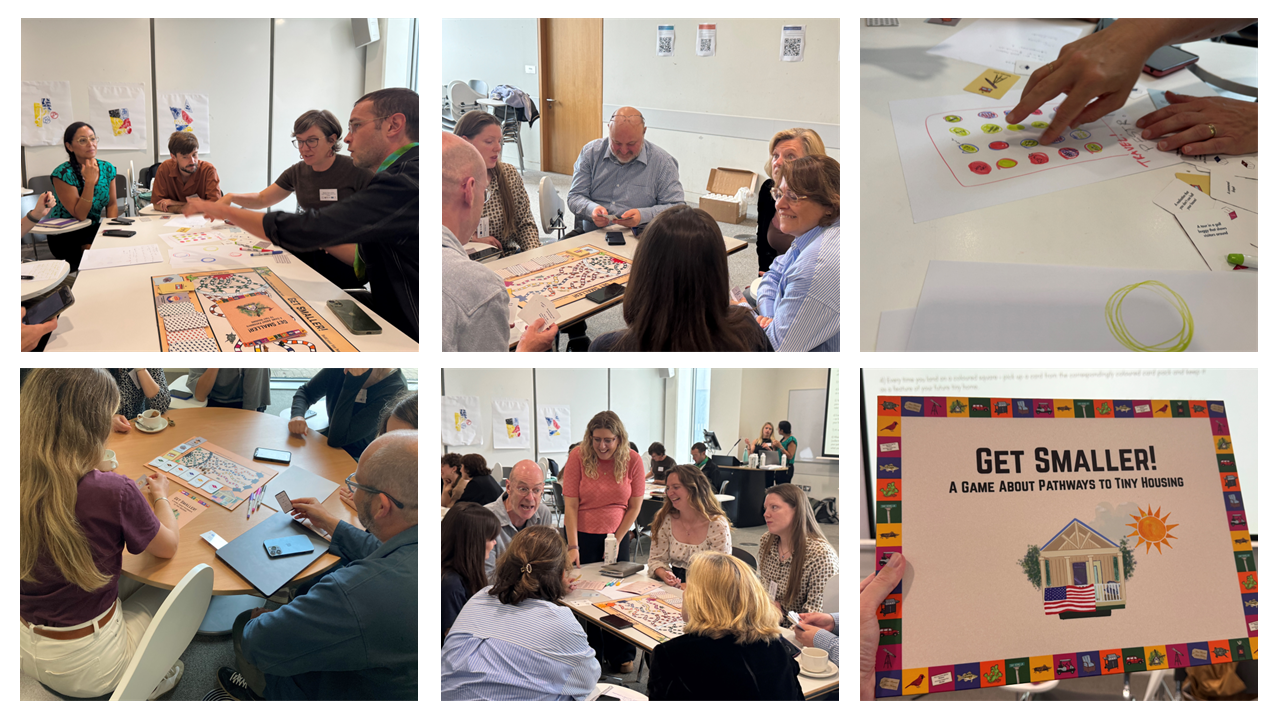
On December 1st 2024 an interdisciplinary group of researchers gathered at UNSW Sydney on unceded Bidjigal land, gathered around the question ‘what can’t data hear?’ The day involved presentations, provocations, discussion and reflection that explored the implications of the datafication of the social world for processes and practices of political voice and listening. Throughout the day, participants considered questions around the increasing ubiquity of datafied voice and listening in a context of widespread neoliberalism. This blog post overviews some of the discussion generated through the workshop. The full program, including abstracts and bios from each speaker, is available here. The workshop was convened by Associate Professor Tanja Dreher, Dr Poppy de Souza and Data Stories post-doc, Dr Danielle Hynes with excellent and essential assistance from Mitchell Price.

Questions of what is left absent when voice and listening are increasingly datafied within neoliberalism are relevant across many topics and disciplines, including (to name just a few) health, housing, education and politics. Reflecting this, the workshop was split into two broad themes: housing and care. The workshop was split into 5 sessions; 4 involved presentations from speakers followed by short discussion, and the final hour was dedicated to discussion and reflection between the whole group. The names of each presenter and a brief word on the focus of their presentation is included here (check out the program for full abstracts of each presentation and a little more detail on the premise of the day).

Housing

  • Claire Daniel – Platformisation of urban planning
  • Sophia Maalsen – Know your Landlord: Bringing attention to data silences
  • Linda Przhedetsky – Being ‘known’ and ‘unknown’ by algorithmic systems in rental housing
  • Alistair Sisson – On counting homelessness: The ambiguous function of By-Name Lists
  • Chris Martin – Rental vulnerability, advocacy and assistance
  • Jacek Anderst – Social housing waitlist data invisibilising housing needs of Aboriginal and Torres Strait Islander people

Care

  • Georgia van Toorn – Ontological misrecognition: Datafication of support plans in the NDIS undermining self-determination
  • Andrew Whelan – Big mental health data for care-less futures
  • Linda Steele – Disability, violence and reparative justice
  • Poppy de Souza – (Un)training the algorithm in an age of datafied (non)care
  • Mitchell Price – Speaking against oneself
  • Diane Stapleton – Desire at the heart of datafication: trans visibility and trans erasure

The remainder of this post recounts some of the discussion that was generated throughout the day.

Image: Workshop participants in discussion

The day began with a focus on housing, generating questions around the tension between platform values and public values, and the increasing dependency of public institutions on platforms in a context where public institutions are increasingly reliant on, and providing funding to, private platforms to facilitate urban planning. The trend of power imbalances being exacerbated through these platforms is not unique to planning and housing, and participants noted there may be a possibility of alliance building across different areas in relation to this.

Discussion following the second session, also focused on housing, generated questions around lived experience/lived expertise, and how we might better attune to and present lived expertise as a vitally important way of understanding how data driven systems works in practice and impact people. Participants noted that it is important to begin with strength based, rather than a deficit based perspective – understanding that lived expertise can constitute forms of knowledge that contribute to theorising and conceptualising how things work, not only descriptive story, or trauma focused (as important as these contributions also are). People impacted by datafied systems use innovative methods of ground truthing to find ways to function/survive within systems that influence their lives, such as (in a social housing related example) driving around town to figure out which properties are empty and requesting to be housed in these specific properties, challenging claims that ‘nothing is available’. The session concluded with a caution; lived expertise can be incorporated into larger systems without meaningfully affecting change, potentially co-opting the potential of this type of knowledge. This theme was to recur throughout the day.

Moving to a focus on care (and acknowledging that care and housing are deeply intertwined), conversation revolved around the importance of mutual recognition, the social nature of identity formation and the difficulty (or impossibility) of fulfilling the need for human recognition of experience and identity through datafied systems. This surfaced across conversations about the datafication of multiple aspects of healthcare, including support plans in Australia’s National Disability Insurance Scheme (NDIS), mental health, and violence and disability. Also prevalent in this conversation was the individualisation of proposed datafied solutions to what are often social problems. Certain values come to be baked into these systems, and these values can be obfuscated. It is important to interrogate how these values come to exist within these systems, and how they are secured.

Important in this discussion was challenging the view that all that is needed is more/better data, and bringing in the idea of reparations. For example, NDIS support plans, plans that are specifically targeted to individuals which are intended to name their self-defined goals and the supports needed to achieve those goals. To be effective, these plans must be monitored and updated continually. An algorithmic system is used to generate a blueprint of support plans for individuals, and the combination of algorithmic bias and funding cuts means that what is meant to be a basic blueprint reviewed carefully by an expert, can become the final support plan without sufficient review. Linked to this was bringing into the conversation the long history of diagnostic criteria that is grounded in eugenics, and the close ties this has to colonialism – noting that bringing the concept of disability into Australia has been part of the violence of the settler colonial project.

Following this the conversation moved to another aspect of care, that people do care about stuff; and the questions were raised ‘how can we recognise and honour what people care about, and recognise the systems that corrode care and make it difficult? Is there another way we could organise our societies?’ One point to follow in response to this is valuing the interdependent and collective nature of care, linking to the history of disability justice movements. Within this exists a tension – at times people are able to build collective, peer led mutual aid groups that provide mutual support, but the existence of such groups may be taken as an opportunity to gut the state aspect of support provision.

Image: Mitchell Price and Associate Prof Niamh Stephenson

Finally, we concluded the workshop with a reflective session. Throughout the day everyone had access to blank index cards, bringing an analogue element into play as we wrote thoughts, questions and points towards a manifesto on these cards. These served as prompt for our final discussion, and were collected and transcribed by Poppy de Souza (thanks Poppy! More to come from this soon). What is written here arose from the verbal discussion, rather than the index cards. Discussion focused on a few themes: the politics of (in)visibility and transparency, how to interrogate the values embedded in systems, what constitutes ‘enough’ data, and the importance of attending to history.

There are tensions around the value and politics of visibility and transparency. Thinking about theories of change and transparency; while transparency is an important principle, it isn’t necessarily clear how it can activate change (as some of the workshop participants have written about). It’s important to remember that transparency and visibility are not end points in themselves – a transparent system may well be unjust and uncaring. Related to this, it is vital to look at the values embedded in systems, more transparency without shifting embedded values will not activate change. A participant asked, ‘how is it possible to understand what values are embedded in systems?’ Some methods suggested included:

  • Discourse analysis and critical discourse analysis
  • Looking at resource allocation/follow the money, e.g. the Australian Tax Office is not sufficiently resourced to investigate/recover corporate tax fraud, but it is highly resourced when it comes to investigating welfare fraud, what value does that represent?
  • Exploring ‘at what point does it stop being possible to see?’: looking up, tracing a system, where is the point that we can’t see anymore. That is a value project, when does it become possible to obfuscate (e.g. resource allocation, values, who’s involved)
  • Looking to perverse outcomes, such as people seeking a type of social housing that doesn’t meet their needs because they know the wait time is shorter for that housing type and that in turn being interpreted as a reflection of the demand for that type of housing, or homelessness By-Name List numbers going down being celebrated as representing a reduction in homelessness when it really represents disenchantment with the system from service providers and people experiencing homelessness and a lack of resourcing for staff to add people to the list. Perverse outcomes such as these show cracks, that the system can never fully recuperate what it claims to represent.

At what point do we have ‘enough’ data? Particularly when it comes to cases where people have shared their stories, their trauma, and there has been little or no action. In these cases the call cannot be ‘we need more data’. The data needs to do something/something needs to be done with it.

Finally, and fittingly, came the reminder about the importance of attending to history, and always asking ‘are the problems and issues with data and datafication new, or are they extensions of existing patterns, systems and power relations? What precisely is new or different?’ Categorisation has long been an essential element of colonisation – the process of dividing and naming. Digitalisation and datafication are also about splitting and demarcating. The digital at its heart is a system of 0s and 1s, a binary system, and there are certainly things that the binary can’t hear.

Some key overlapping themes throughout the day were:

  • The importance of hearing/listening to lived experience/lived expertise as data
  • Attending to perverse outcomes of data generation/collection/analysis
  • Why collect data and what is ‘enough’ data? This linked to theories of change (what is the intended outcome of collecting this data? How will it change things?), data saturation (is collecting more data about this necessary?), and data collection as procrastination (rather than doing something about an issues, are we instead collecting more data about it? Is more information truly needed, or is action needed)

We would like to extend an enormous thank you to all the presenters, facilitators and participants for their generous and generative contributions throughout the day.

Want to share this? (click + below for more options)

New Book: Critical Data Studies

The Data Stories project is please to announce the publication of a new book – Critical Data Studies: An A to Z Guide to Concepts and Methods – authored by Rob Kitchin and published by Polity Books.

The book is available as an open access download, as well in paperback and hardback, from the publisher website.

The book provides a glossary for the field, consisting of 413 entries about key terms. Each entry sets out a definition, a descriptive overview, and further reading.

The text is designed to be a pedagogic resource that enables students and researchers to look up terms that might be used in the classroom or in publications but in a way shorn of a detailed explanation of their meaning, and to act as a guide for discovering ideas, concepts, and methods that might be of value in their studies and analysis.

This information sheet lists all the entries by topic, which provides an overview of the content and might be useful for those seeking related sets of concepts and methods.

Want to share this? (click + below for more options)