All posts by Oliver Dawkins

Call For Papers (2/2): Arts-based and experimental methods in geographical investigation, CIG 2026

This year’s Conference of Irish Geographers will be hosted by University College Cork, Department of Geography with the theme ‘Connected Environments: Integration and Resilience’, on the 6th – 8th May 2026: https://www.conferenceofirishgeographers.ie 

The DataStories team is organising a session entitled: Arts-based and experimental methods in geographical investigation 

Within academia there has been an increase in and acceptance of projects that propose using arts-based and experimental methods to respond to global challenges that require reimagining, reinventing and reorganising approaches to research. In this session we seek to uncover the diverse forms of arts-based and experimental methods used in geographical investigation. We are looking for researchers who are currently engaged in research projects that adopt creative methods. Collectively, we aim to theorise the transformative potential of such methodologies for addressing pressing social, economic and environmental concerns. Beyond considering the benefits of creative methodologies, we are also interested in comprehending the challenges which emerge when incorporating creative methods into research inquiry and the ways we might mitigate or soften possible obstacles to such engagements. 

We invite discussions on the use of arts-based and experimental methods including, but not limited to: 

  • The new and hybrid methods emerging in geography (and cognate disciplines)
  • How different cultural and geographical contexts influence selected methods
  • How specifically arts-based and experimental methods generate new ways of seeing,  understanding and acting
  • Limitations and challenges of using arts-based and experimental methods
  • How creative methods can be used to co-create with stakeholders outside of the discipline and sector
  • Misuse of and ethics around arts-based and experimental methods 

Session organisers: Juliette Davret, Oliver Dawkins, Carla Maria Kayanan, Rob Kitchin and Samuel Mutter
Maynooth University Social Sciences Institute/Department of Geography, Maynooth University 

Please submit abstracts (no more than 250 words) for this special session to Carla Maria Kayanan (carla.kayanan@mu.ie) by 15 March. We will alert you on the outcome of your abstract by 20 March to give you sufficient time to upload your abstract to the CIG portal before it closes on 27 March. 

For a copy of the CFP flyer for this session, click here: PDF

To view the other session we are organising, click here: Call For Papers (1/2): Geographers in the policy arena: Building bridges between academia and evidence-based policymaking, CIG 2026

Want to share this? (click + below for more options)

Call For Papers (1/2): Geographers in the policy arena: Building bridges between academia and evidence-based policymaking, CIG 2026

This year’s Conference of Irish Geographers will be hosted by University College Cork, Department of Geography with the theme ‘Connected Environments: Integration and Resilience’, on the 6th – 8th May 2026: https://www.conferenceofirishgeographers.ie 

The DataStories team is organising a session entitled: Geographers in the policy arena: Building bridges between academia and evidence-based policymaking 

Geographic knowledge is essential for addressing contemporary policy challenges, from climate adaptation and spatial justice to urban resilience and resource management. Yet, significant gaps often exist between the production of geographic research and its effective uptake in policy processes. This session examines how geographers navigate the complex landscape of evidence-based decision-making and explores strategies for strengthening the science-policy interface.  

We invite contributions that critically examine the relationship between policymaking (in both public and private sectors) and the use of geographical knowledge. Of particular interest are perspectives that interrogate power dynamics in knowledge production and the politics of “evidence” itself.  

Topics may include, but are not limited to:  

  • institutional barriers and facilitators to evidence uptake in policymaking
  • increased role of consultants in policymaking
  • the evolution of GIS from data visualisation tools to strategic policy design instruments
  • challenges around what does and does not qualify as evidence for policymaking
  • participatory approaches to geographic knowledge production
  • the use of emerging technologies (e.g. AI-enhanced spatial analytics) in reshaping the evidence base available to policymakers.  

This session aims to share lessons learned from geographers working at the science-policy interface and to build practical frameworks for research-to-policy translation.  

Session organisers: Juliette Davret, Oliver Dawkins, Carla Maria Kayanan, Rob Kitchin and Samuel Mutter
Maynooth University Social Sciences Institute/Department of Geography, Maynooth University  

Please submit abstracts (no more than 250 words) for this session to Juliette Davret (juliette.davret@mu.ie) by 15 March. We will alert you on the outcome of your abstract by 20 March to give you sufficient time to upload your abstract to the CIG portal before it closes on 27th March. 

For a copy of the CFP flyer, click here: PDF

To view the other session we are organising, click here: Call For Papers (2/2): Arts-based and experimental methods in geographical investigation, CIG 2026

Want to share this? (click + below for more options)

3D Printed Model of Cork City Goes Home

We’ve previously shared stories about exhibiting our 3D printed model of Dublin at the Synthetic Cities conference and Dublin’s Beta Festival of digital arts. However, for the last few years we’ve also had a 3D printed model of Cork stored in our lab. Last week the model of Cork finally went to a new home at the library at University College Cork (UCC).

Both models were originally created as part of the Building City Dashboards project. The original plan had been to display both models together for an end of project exhibition but this was prevented when the Covid-19 pandemic struck. After the pandemic we adopted the Dublin model and we’ve been seeking a home for the Cork model ever since.

Last year researcher Maedhbh Nic Lochlainn joined UCC as a lecturer in Human Geography and GIS. As a friend of the Data Stories project, Maedhbh had a good understanding of the model’s value, and this made her the perfect person to adopt and champion it. Maedhbh secured funding to have the model mounted for display by the same team at Display Contracts who prepared the Dublin installation for Data Stories.

Before Christmas I visited the Display Contracts workshop in North Dublin to see the model being prepared. Like it’s Dublin sibling, the Cork model measures 3.5 x 2 metres and covers 28sq km of the city. The key difference between the two is Cork’s hilly terrain. This makes the Cork model significantly thicker and bulkier. Despite the challenge, Display Contracts handled the job expertly.

The piece was delivered to UCC and assembled in the university library last Friday. Students and visitors will be able to explore Cork’s urban landscape in miniature there.

Want to share this? (click + below for more options)

Research Week 2025 at Maynooth University

The Data Stories team was involved in two events during the Maynooth University Research Week.  

Maynooth Sparks 2025: Celebrating Early Career Research  

This year’s Research Week featured Maynooth Sparks 2025, an inspiring event bringing together the university’s early career research community on Tuesday 21st October.   

Behind the scenes, Maynooth postdoc liaison Juliette Davret worked closely with the event organisers, especially Noreen Lacey (from the Research Development Office – RDO), to coordinate the event. Juliette helped shape the panel discussion, bringing in Rob Kitchin to share his perspective on ERC funding and supervising a research team.

The morning began with a series of 6-minute talks in which postdocs showcased diverse research, from energy justice and cosmology simulations to language models and healthcare innovation.  

The following panel discussion on “Funding opportunities & building research teams” was facilitated by Patrick Boyle (RDO) and featured expert insights from the following speakers:

  • Eilish Lynch on career pathways
  • Dr Abeer Eshra and Dr Niamh Wycherley on Research Ireland Pathway Experiences  
  • Dr Guilia Gaggioni on Marie Sklodowska-Curie Fellowships  
  • Prof Rob Kitchin on ERC funding and the supervisor’s perspective

The talks emphasised the importance of tailoring grant application to align with what the specific funder values, clearly articulating the intellectual contribution, feasibility and broader impact of the idea. A strong proposal not only presets a solid concept but also communicates its significance and potential payoff in accessible, compelling terms.  

The event concluded with a networking lunch, allowing researchers to connect with colleagues and RDO staff – the perfect end to a morning of knowledge sharing and community building!  

Daft.ie for Noobs: Gaming Ireland’s property market by spoofing property websites 

On the Thursday of Research Week, members of the Data Stories team hosted a 1-hour interactive workshop titled Daft.ie for Noobs: Gaming Ireland’s Property Market by Spoofing Property Websites. The talk was informed by the work of Oliver Dawkins, Ella Harris, Carla Maria Kayanan and Hannah Mumby who are working on a research project called ‘Commodity Narratives’. The event offered a behind-the-scenes look at how this team of creatives and researchers have been collaborating to interrogate the following themes in relation to the housing crisis in Ireland: a) the commodification of housing, b) the role of capitalism in shaping housing desires (and futures), and c) the use of digital games as a medium testing assumptions and gaining better understanding of peoples lived experiences.  

Prior to the workshop, the team sent a survey to participants inquiring into their personal housing journeys. Answers provided insight into frustrations that people deal with when navigating housing in Ireland. These insights also serve to inform the iterative process of website and game development and help to ensure that the work we produce is meaningful and relevant to an Irish audience. 

Example question: What (if anything) feels absurd about navigating housing in Ireland?  

The aim of the workshop was twofold. We wanted to introduce the work to the Maynooth University community, but we also hoped to test our work in progress to receive feedback. Starting with a short presentation, the team described how creative experiments — from data scraping to gamified website prototypes — seek to expose the absurdities embedded the property market and the logics that underpin it. Following the introduction, Olly showcased early technical experiments underpinning the spoof property site which is modelled on familiar sites like Daft.ie and MyHome.ie.

Participants were then invited to interact with our website, which was embedded with games and various hidden Easter eggs to find which satirise different aspects of Ireland’s property market. Links to pages which dump you on the Craigslist for shared rooms are just one example, mirroring the bitter experience of many student renters who are unable to secure more private accommodation. 

The work is still in progress; including the research informing the webpage, design coherence and mechanics. We hope to deliver a website that sufficiently mirrors popular property websites in Ireland but that the user journey is slightly off, surprising and ultimately jarring so as to provoke reflection on the commodification of housing.

Of course, we also want site visitors to enjoy the satire and have fun! 

To learn more about the early stages of the Commodity Narratives case study and the iterative creative process, visit the Data Stories website previous post: How do commodity narratives influence housing desires and life journeys?


Want to share this? (click + below for more options)

Bringing together urban planning and data: the City Edge case study and workshop

On 17th October 2025, Juliette Davret, Helen Shaw and Carla Maria Kayanan hosted a workshop in Dublin entitled Collaborative Urban Planning with Data, organised as part of the Data Stories project (phase 2). Helen Shaw (artist in residence within Data Stories project for 2025) led the workshop, with Eimear McNally (graphic visual reporter) supporting her. 

The purpose of the case study was to investigate how data informed the City Edge strategic framework and implementation. Following a site visit, 16 stakeholder interviews, desk-based research and an analysis of 37 datasets, the City Edge case study team invited past and present stakeholders involved in the design and implementation of City Edge to a workshop where we could share findings, explore how data shapes urban planning and discuss how we can work better together to plan our cities.

What is City Edge?  

City Edge is a strategic planning project for an area between Dublin City Council and South Dublin City Council. Like many urban planning projects, it involves multiple stakeholders: local authorities, consultants and state agencies. Our research team has been studying how data is collected, shared and use throughout this planning process. 

The video below, which was used by Helen to open the workshop, provides an overview of the challenges and opportunities of the site. 

Findings from our research (to date)  

The research revealed four critical challenges around data governance and the use of data for urban planning in Ireland:  

  1. Data standardisation: Stakeholders use different formats to collect information. This challenges data sharing and creates delays in the planning process. Without a common approach to data governance, it is difficult to plan an integrated urban project.
  2. Data reliability:  Many stakeholders told the researchers that they struggle to access accurate, up-to-date information. Some datasets disappear entirely, while others are difficult to obtain (e.g. additional fee charge). These situations can also hinder the successful roll out of a project, whether it is in the beginning during the fact-finding stage or nearer to the implementation stage.
  3. Data gaps: Key datasets are often incomplete or outdated. Information about tree canopy coverage, habitat mapping, hedgerow data and landscape character assessments is missing or poorly maintained. This finding complements another Data Stories case study (with the CSO), which recently lead to a publication on the property and planning data ecosystem in Ireland. This inconsistency in data reveals that environmental and social values, like biodiversity loss or community well-being, are hard to measure and and/or to integrate into planning models.
  4. Data culture: The researchers discovered limited data literacy across public bodies. This highlights the need to invest not only in data systems but also in the people who understand and manage them.

Additionally, the relationship between local authorities and consultants reveals how consultants currently work with data and raises important questions about the relationship between consultants and local authorities and how these relationships can become more collaborative and innovative. While consultants bring valuable expertise in analysis and scenario development, there is value in ensuring some of these exist and are maintained within local planning departments.  

The workshop: Mapping, Designing and Planning  

Helen started the workshop by welcoming all participants and asking individuals to introduce themselves. This was followed by drone footage of the City Edge planning area. Juliette presented a brief overview of research findings, keeping the presentation tightly focused on data culture and governance. Then, Helen facilitated the main workshop activity through the use of a systems analysis tool called Value Network Mapping and the Berkana Two Loops model – a framework for understanding systems in transition – to encourage the discussion.

Participants identified key roles, relationships and challenges in the planning process. Together, they explored what barriers and opportunities exist and envisioned new ways of working together. Throughout the morning, participants shared their experiences and feedback on both the research findings and the collaborative process.  

Eimear McNally, a graphic visual reporter, captured the discussions in real-time, creating a visual record of our conversations.

What happens next?  

The workshop was just the beginning of forthcoming outputs. From a creative perspective, Helen is in the process of conducting one-on-one audio conversations with participants to create a public story about the case study, similar to her previous work on This Is Where We Live. From an academic perspective, the research remains ongoing. We hope to publish further results in the next few months. 

The Data Stories team would like to thank all participants who joined us for this collaborative session.

Want to share this? (click + below for more options)

Data Stories Research Creation Workshop 2025

Does research creation work? This was the framing question for the Data Stories research creation workshop: The use of research creation and arts based methods in studying housing, planning and the built environment. Held on our Maynooth University campus on 9-10 September 2025, the workshop featured 17 paper presentations and two hands-on workshops that allowed participants to see creative methods in action. The answer to the question is not clear cut; it might work in certain situations and not in others. More likely the answer is: “Yes, it works but…” or “Yes, it works and…”. Research creation might flourish within certain parameters and structures, but flounder when proper scaffolding is missing. Ultimately, the purpose of the two-day workshop was to learn from researchers and artists engaged in research creation to theorise the types of situations, parameters and structures that allow the combination of traditional social science methods and arts-based methods to aid people in generating knowledge and insights about the world we inhabit. 

Carla Maria Kayanan opened up the workshop outlining Phase 2 of the Data Stories project and lessons learned to date. She provided a summary of the literature on research creation to guide participants on existing definitions of research creation. Additionally, Carla included a list of questions submitted by the Data Stories team that served as a provocation for reflection throughout the workshop. Responses to these questions will help the Data Stories team theorise the larger, overarching question of whether or not research creation works and under what circumstances. 

Who is research creation for? 

  • Are there certain sectors more/less amenable to research creation?
  • What is the relationship between the artistic output and contribution to knowledge?
    What do we make in research creation? Does it matter and who does it matter to?

What is the necessary structure for research creation?

  • How do we avoid research creation from being extractive?
  • How can you fit an arts practice into a research schedule with a pre-defined grant structure?
  • What are the biggest institutional barriers to research creation projects and how can we tackle them?

How are the boundaries between the researcher and the artist (un)fruitful, (un)productive and (dis)enabling?

  • When is a researcher and artists and an artist a researcher?
  • How do we break the academic bubble and bring this kind of work and research to a broader audience?
  • In what ways are ‘failure’ and ‘unknowing’ part of the process of research creation
  • What would allow, or better support, early career researchers to step off the hamster wheel of paper-writing and presenting and engage more deeply into different research modalities and thinking speeds? 

Session 1 

Martijn de Waal kicked of session 1 with a presentation based on the work he produced with colleagues at the Centre of Expertise Creative Innovation. On the question of whether research creation is research or art, Martin argues that it’s neither. Rather, it is all research, and it all produces insights; a statement that was backed up with examples from projects he worked on. 

Next up was Christina Horvath, who has a decades long history of working on co-creation. Through examples of various projects across the globe, Christina argued that successful co-creation requires researchers to give up power. Equally, Christina asked us to consider if artists and creative outputs are valued for their aesthetics. This is a question that resonated throughout the workshop, particularly when considering need between the artists and the researcher: Does the artist need the researcher in the same way that the research needs the artist? Or might it be, as Christina questioned during the panel session, that researchers are the parasites in such relationships? 

The final presenter for this session was Léa Donguy, who had previously presented with the Data Stories team at the AAG and was subsequently invited to elaborate on her presentation. In addition to holding down a full-time academic position, Léa is the president of a cultural cooperative within Lab’URBA and has spent over 10 years working with artists as a Geography researcher. Léa described the methodological tools she has developed over time to study the physical environment and environmental extraction. 

Session 2 

After a short break, Session 2 started with Meghan Taylor Holtan presenting an autoethnographic account of a mini circus arts residency in Buffalo, New York, animated by efforts to communicate questions and data around the social, economic, political and embodied dimensions of housing energy efficiency. The account demonstrated an unfolding process of inquiry around the possibilities and challenges (creative and critical, but also practical/logistical) of communicating these questions through an integration of Holtan’s background as a circus artist and instructor with more traditional quantitative methods, culminating in a juggling film installation on a net zero energy demonstration home.  

Next, John Bingham-Hall presented work from Staging Ground, a creative residency as part of the research platform Theatrum Mundi. The project brought together professionals (e.g. architects, choreographers and filmmakers) with Paris residents, activists and planners to walk and ‘re-choreograph’ cultures of movement of large transport infrastructures, specifically the metro and Périphérique ring road. The project resulted in the production of works, such as film, which highlighted the human or other mundane lives of these infrastructures. Bingham-Hall reflected on how the co-production of ‘embodied’ research might shape concrete planning processes.    

Giada de Coulon and Frédérique Leresche presented on a participatory film-making project in which groups struggling with precarious living conditions in Switzerland (including women, undocumented migrants, and LGBTQIA+ groups) were given cameras with which to respond to the question of what ‘home’ meant to them. As well as a mode of expression for revealing different experiences of precariousness, potentially countering conventional narratives around what constitutes (a) ‘home’, the creative methods of the project also raised ethical and political questions around representation and aesthetics.   

In the subsequent discussion, participants followed up on matters of ‘translation’ and ‘representation’ raised across the presentations. There was a question posed around whether meaning is lost in the conversion of embodied, participatory work and experience into visual or other representations (such as film or photography). It was also asked whether art (and indeed academic research) ‘speaks for itself’; to what extent or at what point it requires framing or contextualisation for audiences.   

The issue of funding for this kind of knowledge-production was also discussed, including how, under conditions of precarity and ever-decreasing financial support for the arts, the continuous making of work was seen as a necessary means of maintenance, facilitating opportunities for networks, further work, or for tactically accessing small pots of funding.

Session 3 

Cecilie Sachs Olsen began the third session of the workshop with a presentation titled ‘Oh the Drama! Research creation as participatory theatre-based method to accommodate conflict in urban planning’. Cecilie described a process she was part of designing, alongside collaborators, called Drama Labs. These involved bringing together participants who are part of conflicts around urban planning to partake in a form of participatory theatre. Cecilie teased out how the Drama Labs assisted in making conflict productive through examining three elements of the process: estrangement, embodiment and entanglement. 

Next, Oliver Dawkins presented his work supporting the Performance Corporation in their development of a theatre show about housing in Ireland titled Pretty Vacant. Oliver reflected on the process of undertaking research, bringing data into the performance space, preparing a punk song, and performing on stage. Oliver’s discussion explored the convergences and divergences that arise in the creative process and the necessity for different strands of the research development to be gathered up or set aside for the sake of the final output. 

Following Oliver, Ivis Garcia discussed strategies of engaging communities in anti-displacement planning. Ivis recounted the various creative modes used to assist in engaging communities, including putting up posters, sending postcards, hanging signs on doorknobs, and youth engagement with tracing stencils on the pavement. 

Finally, Mel Galley reflected on her work as part of the Data Stories team, working alongside Juliette Davret and a data intermediary company utilising speculative writing. Mel highlighted the benefits of engaging in speculative writing in a research context, including offering a space for ambiguity and playfulness, and the possibility of reflecting on what is occurring in the here and now. 

Session 4 

The first talk in our fourth session was given by Sarah Gelbard, who discussed a series of community-based workshops which used collage and zine making as collaborative methods for identifying better housing outcomes. Designed for vulnerable people with lived experience of housing insecurity and incarceration in Canada, the workshops were prompted by the speculative question ‘What would housing be like in a world without prisons?’. Responding to this prompt, participants were encouraged to move beyond discussion of their own personal experiences to identify more systematic forms of harm affecting them and to propose their own alternatives. An important part of this process for Sarah was recognising the need to compensate participants for their time. 

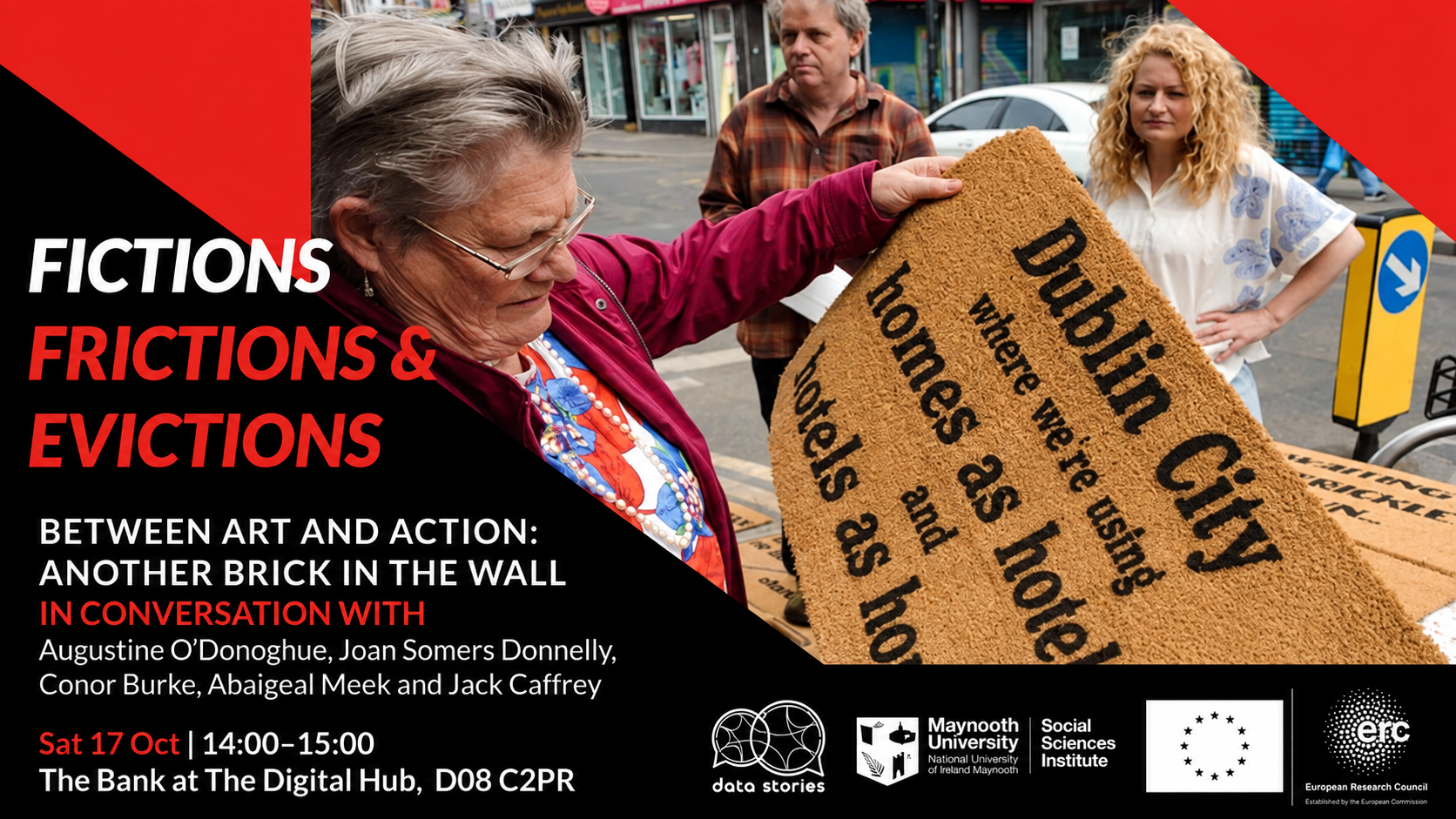
Danielle Hynes and Samuel Mutter then discussed their collaborative work with Data Stories’ artists in residence Mel Galley and Augustine O’Donoghue. The talk contrasted their use of traditional social science methods with more creative projects involving different writing and communication methods, including zine-making, the use of Excel grids for story composition, posting texts through letterboxes, and the creation of data-informed doormat messages to communicate with door-knocking politicians. The talk also constructively discussed the tensions that can arise between academia, the arts, and their use of data, and the ways in which creative methods might better be employed to mediate their dependencies and improve collaboration. 

In the final talk of this session, Nazanin Karimi discussed her work engaging students in processes of counter-mapping in the Netherlands to help expose, politicise and propose alternative arrangements for a range of housing challenges. In these counter-mappings participants were encouraged to engage different narrative and sensory modalities to inform hand-drawn maps which focus on fluid and dynamic aspects of urban living which are not well captured by more formal approaches to mapping. What this activity uncovered are the many informal adaptations people make to prevalent housing conditions, also intimating how those conditions might be made more favourable.


Session 5 

The last session of the workshop included three presentations. Joan Somers Donnelly shared how the success of research creation depends on the level of openness and buy-in from those involved. Comparing two case studies that used arts-based activities during workshop activities, she showed how different contexts either allowed collaboration to flourish or made it much harder to achieve meaningful impact.

Conor Moloney took us into the playful yet staged public spaces of London. Using his background in architecture, he began experimenting with drawing not just as documentation but as a creative way of layering protest, play, and place into cityscape.  

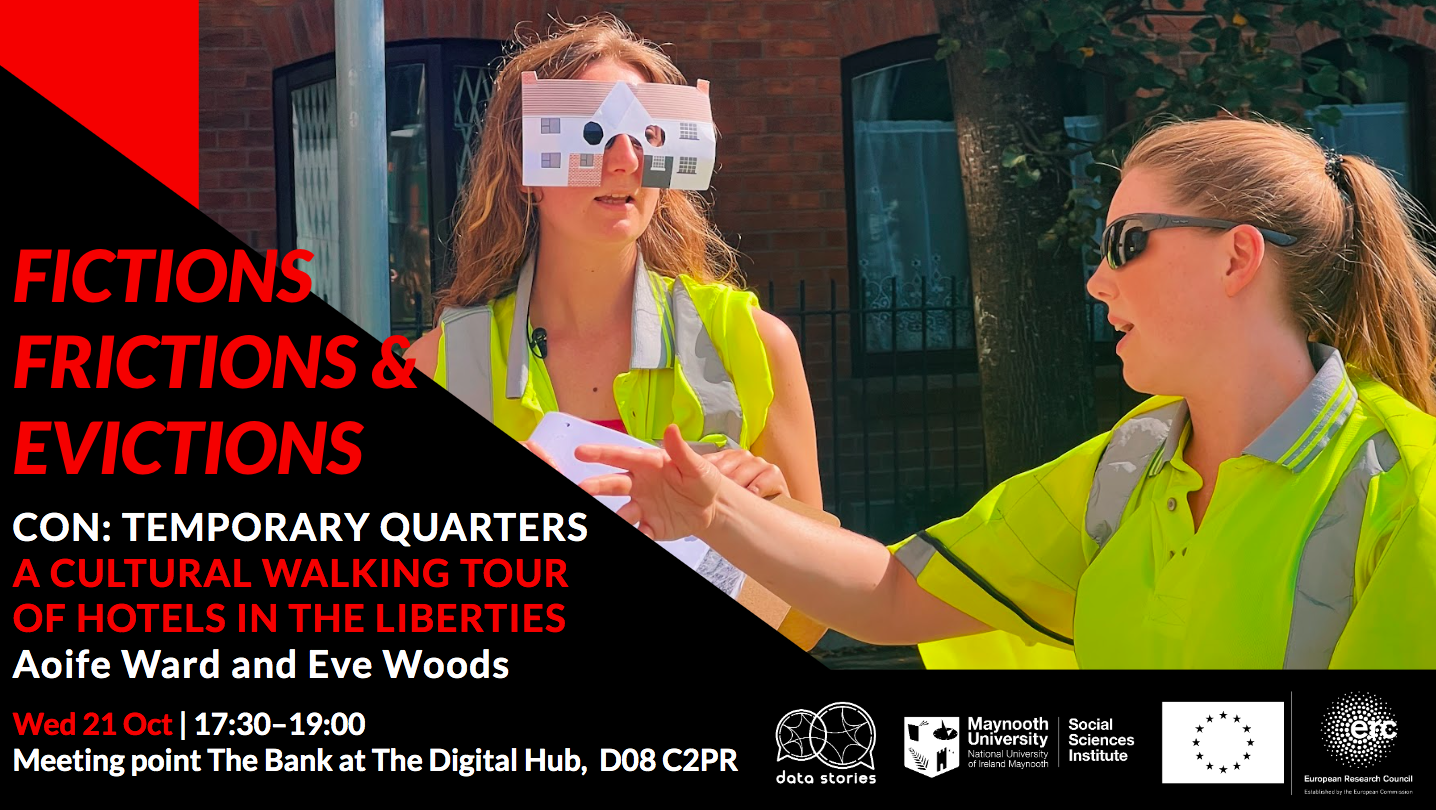
In Dublin’s Liberties, researcher Lidia Manzo  and artists Aoife Ward and Eve Woods  told the story of how their collaborative project uses satire through hotel walking tours to push back against gentrification. Their work highlights how art can question who cares for urban spaces and how communities can resist the loss of culture and identity.

Across this session, a shared theme emerged: artists bring something different yet essential to research, but their contributions are often undervalued and underfunded. Speakers stressed that artists should be part of the process from the very start, and that researchers also need time and space to engage with artistic methods in ways that feel meaningful. Research-creation, as our speakers showed, is not just about new methods, it’s about rethinking how knowledge, community, and creativity can come together to imagine better futures.

Workshops 

Two workshops, one held on each day, were scheduled to allow workshop facilitators to demonstrate the use of arts-based methods in action. The first, facilitated by Agata Gunkova, Madeline Isobel Mesich and Margareta Relijić focused on imagined housing futures. Participants were asked to individually reflect and write down what it meant to integrate care into housing. Split into small groups, participants discussed what a caring housing could look like. Following the discussion, individuals were given a piece of lino and carving tools to sketch and carve a caring housing utopia.  Each of the pieces that the small groups used connected like puzzle pieces to a create a whole. Participants then painted their pieces and stamped them into connected wholes on poster board. The produced outcomes were used to further the discussion on alternative housing futures. 

The second workshop was facilitated by Ella Harris and Mel Nowicki based on previous research on the use of tiny homes in Austin, Texas. The research project led to a Tiny House Boardgame, which Ella and Mel introduced to the group through game play. Players navigated the board as characters, derived from Ella and Mel’s research. Each player had a fixed budget and chance cards that reflected housing experiences and/or setbacks. At the end of the game, players could ‘see’ their tiny housing reality based on the journeys they took, and the material possessions picked up along the way. The latter half of the workshop kept the theme of game play. Participants were given a short amount of time to develop a game based on housing. The game design that each table created was later shared with the group. The experience of creating a game helped participants reflect on the usefulness of games as a research tool.

At the end of the two engaging and insightful days, packed with paper presentations, workshops and shared meals, Rob Kitchin closed the workshop with an overview and summary of lessons learned and questions for further reflection and inquiry. We intend to answer some of these questions and to push the dialogue further through an edited volume theorising research creation. We’ll be sure to let you know when that comes out!

Presentation Slides


Want to share this? (click + below for more options)

Data Stories goes to Belfast for CIG 2025

Earlier this month Samuel Mutter and Danielle Hynes attended the Conference of Irish Geographers 2025, held at Queens University over three exceptionally sunny days. Danielle and Sam presented in two sessions: ‘Creative Methodologies’ and ‘Critical Geographies of Housing’.

[Image: The Elmwood Building, QUB, where the conference was held.]
In Creative Methodologies, Danielle and Sam discussed two aspects of their current work, focusing on their ongoing collaboration with artist Mel Galley on the theme of ‘data narratives’ and nascent work around photographing planning site notices around Ireland. In a presentation titled ‘Telling Data Otherwise: Creating Housing Data Stories through Researcher-Artist Collaboration in Dublin, Ireland’, they reflected on the collaborative process with Mel, tracing the work of artist and researchers to find ways of unsettling, countering or responding to mainstream data narratives of housing and planning through practices such as grid-based story writing. Meanwhile, reflections on site notice photography raised the potential for such approaches to foreground the emplaced and material qualities of data in the built environment.

[Image: Danielle and Sam presenting their work.]
Two other excellent presentations were delivered in this session. The first was from Gerry Kearns, Isabella Oberlander, Fearghus Ó Conchúir and Karen Till who discussed dance as a form of knowledge and the possibilities of tearmann aiteach / queer sanctuary. The second came from Ruodi Yang, who is exploring public space under neoliberalism through the lens of street performance.  

In the Critical Geographies of Housing session Sam presented findings from CATU’s Eviction Nation report, in place of Fiadh Tubridy who was unable to attend. Danielle presented on work undertaken during her PhD, examining the shift from government managed public housing to NGO-owned and managed community housing. This presentation was in conversation with Maedhbh Nic Lochlainn’s work, who also presented in this session, examining the similar shift from social housing delivered by Local Authorities in Ireland to the increasing growth of the AHB sector.

[Image: Sam presents Eviction Nation.]
On the final day, attendees were invited on one of two field trips. Danielle attended a bus tour of Belfast, led by geologist and geophysicist Alastair Ruffell. Attendees visited various sites around Belfast and heard a little about the history of the city. Visiting the peace wall, two graveyards, and the new Grand Central Station (to drop off everyone heading home), Alastair told us some of the history of the city and his part in it as a forensic geologist.

We’d like to thank the organisers for such a wonderful and well run conference, and to all those who attended sessions where we presented and asked such engaged questions.

Want to share this? (click + below for more options)

AAG Conference Recap: Sessions, walking tour and print making workshop

In the last week of March, Rob, Juliette and Carla’s schedules were packed full with a week-long attendance at the American Association of Geographers (AAG) Annual Meeting, held in Detroit, Michigan. This was the first AAG for Juliette, and a return after many years’ absence for Carla and Rob. It must be said that the sessions certainly did not disappoint. The week was packed with sessions organised by the team and papers presented by them, but we also co-organised a tour of Detroit and a print-making workshop. Below we highlight some of the key moments from the conference.

Data, Housing and Planning I & II 

Prof. Rob Kitchin Presenting at the AAG 2025

Despite flying all Sunday and feeling jet lagged, the Data Stories team, along with co-organiser Dr. Taylor Shelton, had the (mis)fortune of having their first back-to-back sessions slotted for Monday, the very first day of the conference, at 8.30 am. A total of 8 papers were presented on the themes of data debates, deriving sentiment from housing on data, data narratives and the politics and complications of aggregating housing data. Rob Kitchin presented work from phase 1 of the project in a paper titled, Data debates in housing and planning: The data politics of facts and counter-facts. Overall, the papers presented in this session were excellent. If all goes as planned, a selection of these papers will become part of a special issue in a housing journal. We will update the blog with details when that happens. 

Theoretical Perspectives on Research Creation in Place and the Built Environment I & II 

Carla Kayanan presenting at AAG 2025

The second organised session was also held bright and early at 8.30 on Wednesday. Two back-to-back sessions brought together researchers and artists working at the intersection where social science methods and arts-based methods intersect. A total of 9 presenters used wide-ranging case studies (green and blue environments, transportation, disability, war, data dashboards) as well as a series of mediums (comics, workshops, storytelling, archiveology, sculpture, visual storytelling, photographs) to theorise research creation and the co-creation of knowledge. Carla Kayanan opened up the session with a paper titled, Exploring the synergy between artistic practices and academia in shaping the built environment towards research-creation methods. This paper builds on previous work on research creation but draws from longer engagement with the first set of artists in residence. 

Juliette Davret presenting at AAG 2025

The final paper-related event occurred on Thursday with Juliette Davret presenting the paper Rethinking datafied movements: A critical comparison of direct action and lobbying as data activism in an urban context. This paper was accepted in Dr. Eugene McCann and Dr. Magie Ramirez’s pre-organised session, Futures of organizing and the urban: Confronting crisis in theory and practice. 

Exploring beyond the conference 

Outside of Huntington Place’s walls, the convention centre that housed the AAG, the Data Stories team members engaged in events that gave them the opportunity to experience Detroit’s built environment and its artistic community. On Thursday afternoon, Detroit scholar and historian, Dr. Patrick Cooper-McCann, took a group of Irish Geographers on a walking tour of downtown Detroit. 

Walking Tour of Detroit at the AAG 2025

The walk consisted mostly of discussions outside of buildings along Woodward, however we did enter the Guardian building and the Whitney hotel. 

Finally, on the last day of the conference, Data Stories team members tagged along with Australian Geographers to attend a workshop by visual artist and printer Wendy Murray hosted in the workshop of Amos Paul Kennedy Jr. Wendy kindly took a morning to share her love of printing with the group. As part of the event, Dr. Kurt Iveson lead us on a walk of Wendy’s Detroit neighbourhood while the group, per Wendy’s request, focused on emergent feelings from the walk. These sentiments were then used to co-create a series of prints that Wendy then gifted to us. Additionally, though absent on the day, Amos had generously prepared a series of prints to present to our group. We cannot encourage you enough to purchase Amos’s beautiful and recently released book, Citizen Printer, and to read more about him and his work in this 2024 article by Charlotte Beach. 

Want to share this? (click + below for more options)

Call for papers – Special Session at 4th Digital Geographies Conference, 3-4 November 2025, Lisbon.

Data Voids: Understanding Digital Geographies of the Built Environment through Negativity and Refusal 

Session Organisers: Danielle Hynes & Samuel Mutter 

Emerging work in cultural geography has called on researchers to consider the (im)potential of ‘negative’ spaces and affects, asking what can be done with voids, limits and (in)capacities of different kinds (e.g. Bissell et al, 2021). Meanwhile, across media and cultural studies, critical data studies and feminist and political geography there is growing attention to the possibilities of refusal (e.g. James et al., 2023), particularly refusal as a collective and generative response to datafied systems. Both bodies of work are concerned with gaps, absences, silences and negation, though with varied foci and orientations toward action. 

Our session seeks to bring these literatures into conversation, with a particular focus on digital data and the built environment. 

The governance of built environments is increasingly informed and narrated through digital data – from ‘evidence-based’ planning, to the modelling of land/housing markets, and uses of ‘proptech’ to facilitate investment or discipline tenants, data seem almost as foundational as bricks and mortar. Yet such data are often characterised by absences, gaps and silences. Such absences prompt initiatives to fix, ‘free’ and/or repurpose the data in order to enhance access and transparency. However, recent work problematises transparency as a universal response to data-driven systems, pointing to refusal and data justice as approaches pursuing a structural shift relative to data harms. 

The session will seek theoretical and empirical contributions pertaining to questions including, but not limited to: 

  • What might an attention to data voids from the perspective of negative geographies and refusal illuminate? 
  • How do absences of data shape the built environment? 
  • How do acts of refusal in the face of data-driven governance generate meaningful political and spatial alternatives? 
  • How might methodological approaches to data be developed or reconceived through working with refusal and negativity? 
  • How do we reckon with refusal alongside the politics of data suppression? 
  • How do we register what or who is left absent (unbuilt, unseen or unheard) by/through data in its shaping of built spaces? 

Papers from this session will be considered for a potential Special Issue in a relevant journal.

Submit abstracts (max 250 words) by *April 30, 2025* here, selecting Special Session 8. 

More information about the conference can be found here. 

Notifications of acceptance will be sent by *May 15, 2025*. 

Want to share this? (click + below for more options)

Call for papers – The use of research creation and arts-based methods in studying housing, planning and the built environment

Call for papers, with travel bursaries 

The use of research creation and arts-based methods in studying housing, planning and the built environment
9 – 10 September 2025
Maynooth University, Ireland
Organisers: Rob Kitchin, Carla Maria Kayanan, Juliette Davret and Oliver Dawkins  

We are seeking participants for a two-day workshop that will explore the use of research creation and arts-based methods in studying housing, planning and the built environment. The workshop is organised as part of the ERC funded project, ‘Data Stories: Telling Stories about and with Planning and Property Data’ (https://datastories.maynoothuniversity.ie/). 

We are offering: 

  • 10 travel bursaries for speakers, 5 up to €800 with 3 night’s accommodation (for beyond-Europe travel) and 5 up to €250 with 2 night’s accommodation (for within-Europe travel). The bursary is open to doctoral students, early career researchers, senior academics and artists. 
  • 3 travel bursaries for doctoral students to attend the workshop of up to €250, plus 2 night’s accommodation.  

Workshop focus  

Over the last two decades, there has been a turn towards using creative and arts-based practices within social sciences to research aspects of society. Research-creation is an approach that utilises creative and arts-based practices and methods throughout the entire research process from the formulation of a project, through its enactment, to its dissemination (Loveless 2019, Truman 2021). Methodologically, such research might use various forms of creative writing (e.g., speculative fiction, poetry, short stories, creative non-fiction), art and craft practices (e.g., painting, photography, sculpture, textiles) and performance (e.g., theatre, film-making, music) as participatory methods to generate shared insight into an issue. Using a research creation approach provides opportunities for opening up new ways to conceptualise and understand issues related to housing, planning and the built environment.  

This workshop aims to explore and theorise:  

  • the potential of research creation as an approach for making sense of housing, planning and the built environment; 
  • the implications of different artistic / creative practices for the co-production of knowledge  
  • the implications of different models of collaboration (e.g. the artist plus researcher pair vs. the artist doing research/researcher doing art)  

We are open to other exploring and thinking through other relevant issues and questions. While we will organise traditional paper-based sessions, we are also open to alternative modes of presentation and session formats. Following the workshop, selected speakers will be expected to contribute a full chapter to an edited academic book of the workshop proceedings. 

We invite applications to attend the workshop from scholars, artists and scholar-artists who are using a research creation approach or arts-based methods to conduct housing, planning and built environment research. We seek contributions that emphasise epistemological inquiry rather than those that primarily showcase the outputs of using arts-based methods. Papers that critically consider arts-based methods in the social sciences, engage with data, and focus on housing, planning, and property will be prioritised.

Application process 

To apply to present a paper and receive a travel bursary please submit a short cover letter explaining why you would like to attend, a title and a short abstract (150 – 200 words) to both carla.kayanan@mu.ie & juliette.davret@mu.ie (using the subject line ‘CFP RESEARCH CREATION WORKSHOP’) by 14th March 2025. 

To apply for a doctoral student travel bursary to attend the workshop please submit a cover letter explaining why you would like to attend to both carla.kayanan@mu.ie & juliette.davret@mu.ie (using the subject line ‘BURSARY RESEARCH CREATION WORKSHOP’) by 14th March 2025. 

A decision on selection will be made by 14th April 2025. 

For any queries please jointly email carla.kayanan@mu.ie & juliette.davret@mu.ie 


Want to share this? (click + below for more options)