We are delighted to be part of the Research Handbook on Digital Data: Interdisciplinary Perspectives, a new volume bringing together scholars from a wide range of fields to investigate digital data and its growing role in contemporary life. The book delves into the role and consequences of digital data across multiple dimensions of organisational and social life.
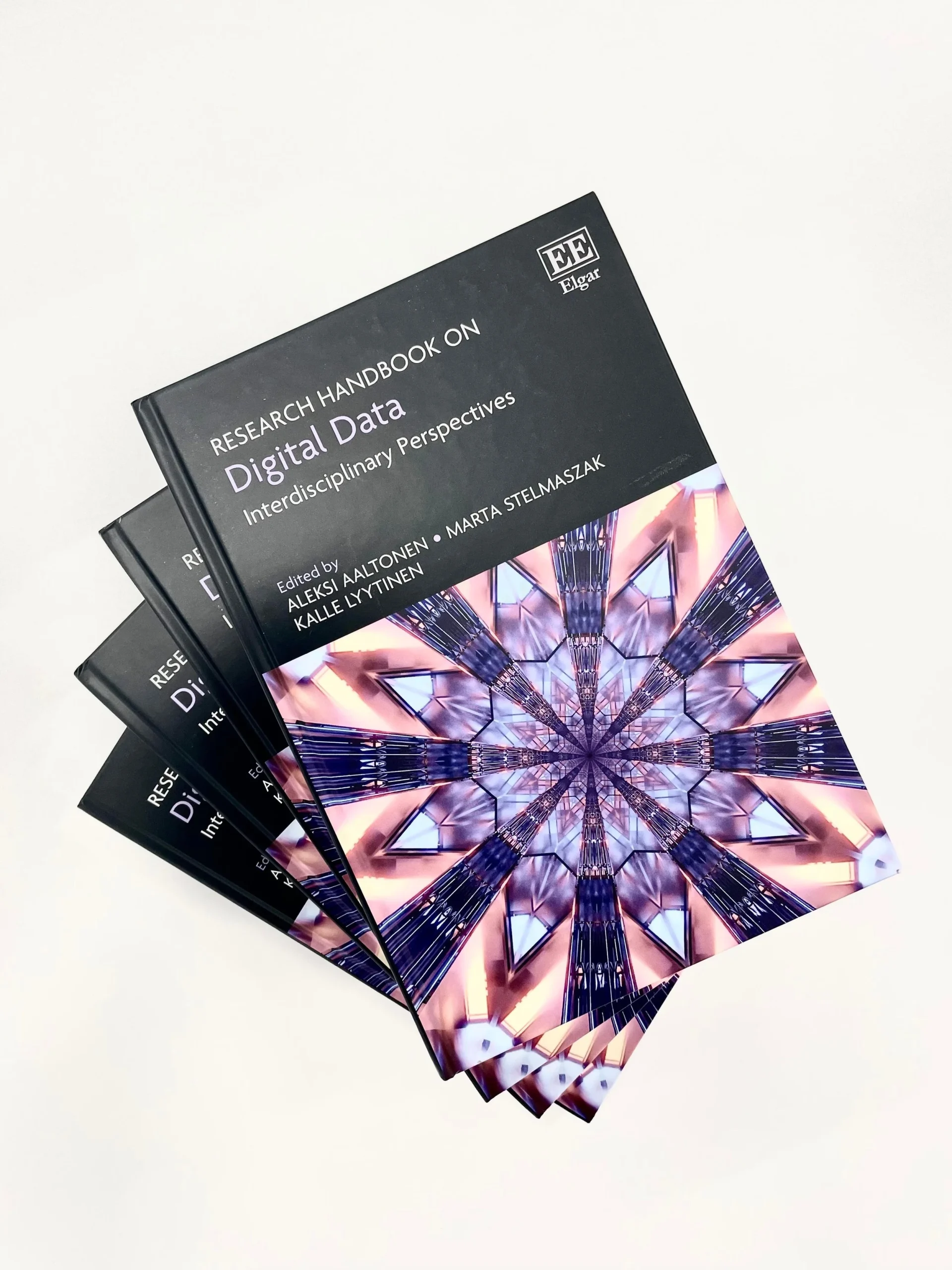
Spanning 408 pages, 24 chapters, and 56 contributors, this Research Handbook surveys critical scholarship across several disciplines, from management and sociology to economics and geography, building a solid conceptual foundation for understanding the growing significance of digital data in today’s world.
The book is organised into six sections: an introduction, followed by Data Foundations, Data Design, Data in Practice, Data Governance, and Data Use, and closing with an afterword. Our contribution sits within Section 5 of the book, dedicated to Data Use. This section examines how the digital turn and data-driven systems are reshaping the way different domains are organised, managed or governed, as well as the practices implemented within them, and how this continues to evolve with emerging developments such as synthetic data or distributed machine learning. The chapters collectively raise and tackle both new and longstanding issues that demand social, political, regulatory and legal responses, around questions of privacy, ethics, data droughts and deluge, hallucinations and more.
Our chapter “The nature and development of a planning data ecosystem” is accessible in our open access archive [here]. It examines the nature and development of data ecosystems through a comprehensive case study of Ireland’s planning development and control data ecosystems from 2000-2024. Using assemblage theory as a theoretical framework, we conceptualise data ecosystems as assemblages of data assemblages — complex socio-technical arrangements that evolve through non-linear, contingent processes. The Irish planning system demonstrates how data ecosystems develop through “jerry-rigging” over time, involving 31 local authorities, national agencies, and various digital platforms that create both functional workflows and significant data frictions. The research employs qualitative methodology including stakeholder interviews, system mapping, and data flow analysis to reveal how technical incompatibilities, organisational cultures, and resource constraints impede data mobility across the ecosystem. Despite operational challenges, the system functions through adaptation and ongoing reform initiatives. The study contributes to understanding data ecosystems as emergent, palimpsestic socio-technical configurations requiring further empirical and theoretical investigation across sectors and domains.

The book was launched on April 1 by its editors Aleski Aatonen (Stevens Institute of Technology), Marta Stelmaszak (Isenberg School of Management, University of Massachusetts Amherst) and Kalle Lyytinen (Case Western Reserve University). During the launch, Rob Kitchin presented the section on Data Use where our chapter appears. The launch drew 138 live participants, and you can (re)watch the recording [here].
It took almost exactly two years from the initial idea to the publication, and the Data Stories team is glad to be part of it!
—————–
Book chapter reference: Davret, J., Kayanan, C. M., Kitchin, R., & Mutter, S. (2026). The nature and development of a planning data ecosystem. In A. Aaltonen, M. Stelmaszak, & K. Lyytinen (Eds.), Research Handbook on Digital Data (pp. 324–342). Edward Elgar Publishing. https://doi.org/10.4337/9781035348718.00032