Data Stories and Arts-based Methods: Introducing the Artists

We’re pleased and excited to introduce the first cohort of artists to join the Data Stories team. Joan Somers Donnelly, Mel Galley and Augustine O’Donoghue will be helping the team to explore arts-based methods as a means for research-creation. Typically, arts-based methods are integrated into research projects toward their conclusion to communicate findings to the public in novel ways.

What makes this method stand out is that, with the integration of our artists and their specific skill sets, we will embed creative approaches throughout the entire research process. So rather than giving the artists our findings and asking them to share them to the public, they are working with us at the onset to change the way we approach our own work and challenge our pre-conceived understandings of Dublin’s planning, property and housing systems.

In the coming months each artist will team up with one Data Stories researcher to create data stories that respond to issues and challenges raised during our mapping of the policy, planning and housing data ecosystem in Ireland. While working with our researchers and various external stakeholder organisations, each artist will also develop their own data story concepts that express their unique approaches to artistic practice.

We hope you look forward to seeing the outcomes as much as we do.

Joan Somers Donnelly
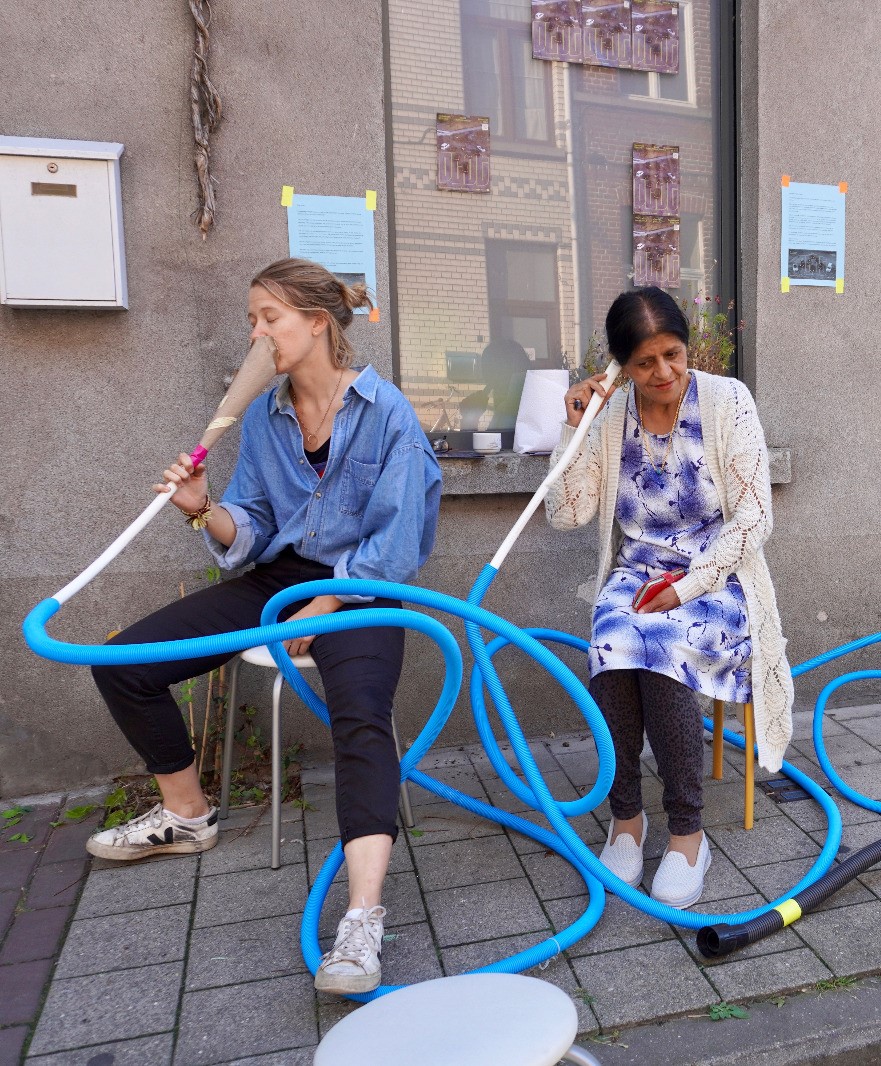
Photo credit: Elien Ronse

I am an Irish artist based between Brussels and Dublin, with a collaborative practice that moves between performance, writing, research and organising. Previous work includes a human choir that performed for cows; a piece for swimmers in the Irish sea; an interactive fantasy about the politics of housing in Dublin; a video essay about social spaces of gig economy workers made with my father; and performances and other invitations for lamp posts, zoom calls, U-bahn stations and apartments.

My practice is primarily concerned with examining existing social rules and structures and creating not-yet-existing ones, using performance and other live situations as a testing ground for experiments in different ways of relating. Much of my recent work has focused on the creation of frameworks for playful encounter, exchange, and co-creation, such as the group improvisation practice messing, the platform for collaboration You and Me, an Anger Club, and a first manifestation of a practice-sharing space for women and non-binary multimedia artists called In practice(s): The wood and the trees. My work is currently supported by the Arts Council of Ireland and radical_house, Brussels.

I was drawn to the Data Stories project because of a long-standing engagement with the politics of space and space-making in Dublin, both in and outside of my artistic practice. I am also looking forward to working as part of an interdisciplinary research team, and to the new challenge of working with stakeholders across the public, private and civil society sectors. A practice-based research approach has become increasingly present in my work, particularly around the question of how to create conditions for collaboration between diverse actors from and in different contexts, so this residency presents an interesting next chapter in that trajectory.

Mel Galley 

Currently based in Dublin, Ireland, I grew up between the Dales and Cumbria in the UK. My closeness to these rural landscapes has heavily influenced my research; specifically how industrial or military activity exists alongside motifs of ‘wilderness’ in these areas. Growing from an early (and ongoing) love of science-fiction and anti-/utopian literature, in my practice I construct unreal places, translating ideas through mediums from contemporary technologies of CAD and CGI to laser etching and printmaking. Creating these unreal places allows me to analyse and reorder research, offering an alternative point of entry into existing discussions on place, ecology and ethics. Frequently my works are shown as multiples, such as pamphlets or handouts, which the audience can take out of the arts space with them and into the landscapes that they consider. The draw to join the Data Stories project, for me, was the focus around data and place, specifically through the lens of politics, ethics and narrative. I’m excited to be spending a year working alongside the researchers on this project to develop art works and workshops with and about the data!

I’ve shown work across Ireland and the UK, participated on artist residencies in Manchester, Cumbria and Dublin, and delivered classes and workshops at three universities. In 2021 I was awarded 2nd Place Practitioner Category in the RIBA Eye Line awards and in 2020 received the award for Young Cumbrian Artist of the Year (a real joy to be recognised by the county I’m from). Two of my works are held in the collections of the Bodleian Library, Oxford, whilst many more are on the walls and shelves of people I care about – which is equally meaningful to me.

Augustine O’Donoghue   

I am a socially engaged visual artist based in Dublin. My artwork engages with a range of local and global socio-political issues. Over the last two decades my art projects have been research based and collaborative throughout their development and creation. I use an array of socially engaged and participatory approaches to develop interdisciplinary projects and have collaborated with diverse groups of people including students, scientists, migrant workers, academics, refugees and social organisations across Ireland, Latin America and Africa.

The Data Stories project really captivated my interest as it was an opportunity to draw together many topics and strands of my art practice that I feel really passionate about. The projects original research concept of using data stories to explore the data and analytics relating to property and planning, the opportunity of using creative methodologies to work with stakeholder groups that may not traditionally work with artists and having direct access to the research team and their vast knowledge and experience will allow me to create new work in an exciting and innovative way. More importantly it will allow me to create new work with a level of criticality that would be challenging to achieve without this project.

To learn more about the use of arts-based methods in research creation, please read the project working paper ‘Arts-based methods for researching digital life.’  forthcoming as a chapter in ‘Researching Digital Life’, James Ash and Agnieszka Leszczynski’s co-authored book.

PDF: https://mural.maynoothuniversity.ie/16870/ 

Want to share this? (click + below for more options)

Data Stories and the Synthetic City: Exploring Urban Living through the Data City Dublin Exhibit

The Synthetic City conference took place at Dublin City University (DCU) on the 6th and 7th of September 2023. Hosted by the ECREA Media, Cities and Space Section, the conference attracted researchers in cities, media and the arts from across the globe to explore the impact of artificial intelligence and digital media on cities and urban living. 

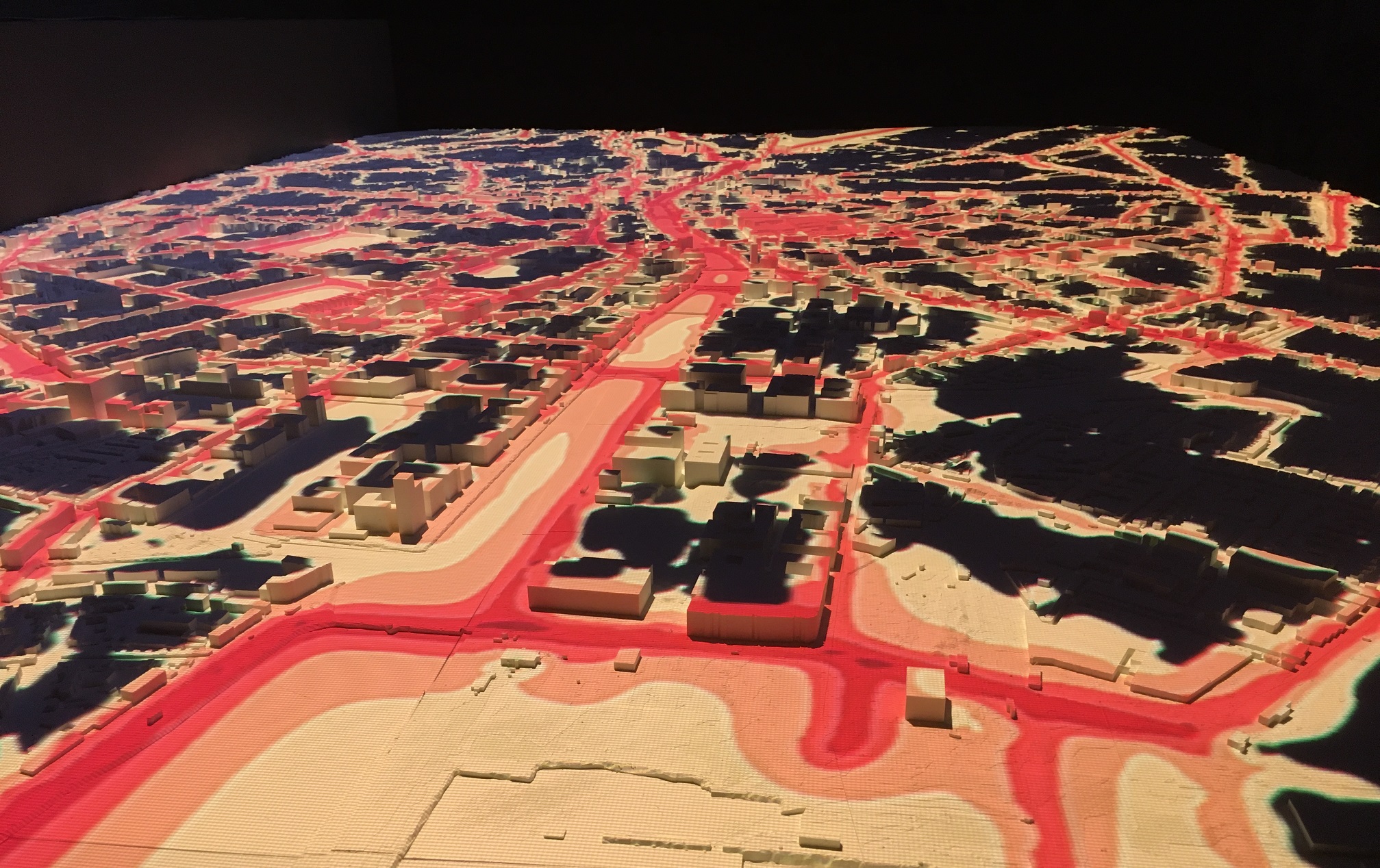
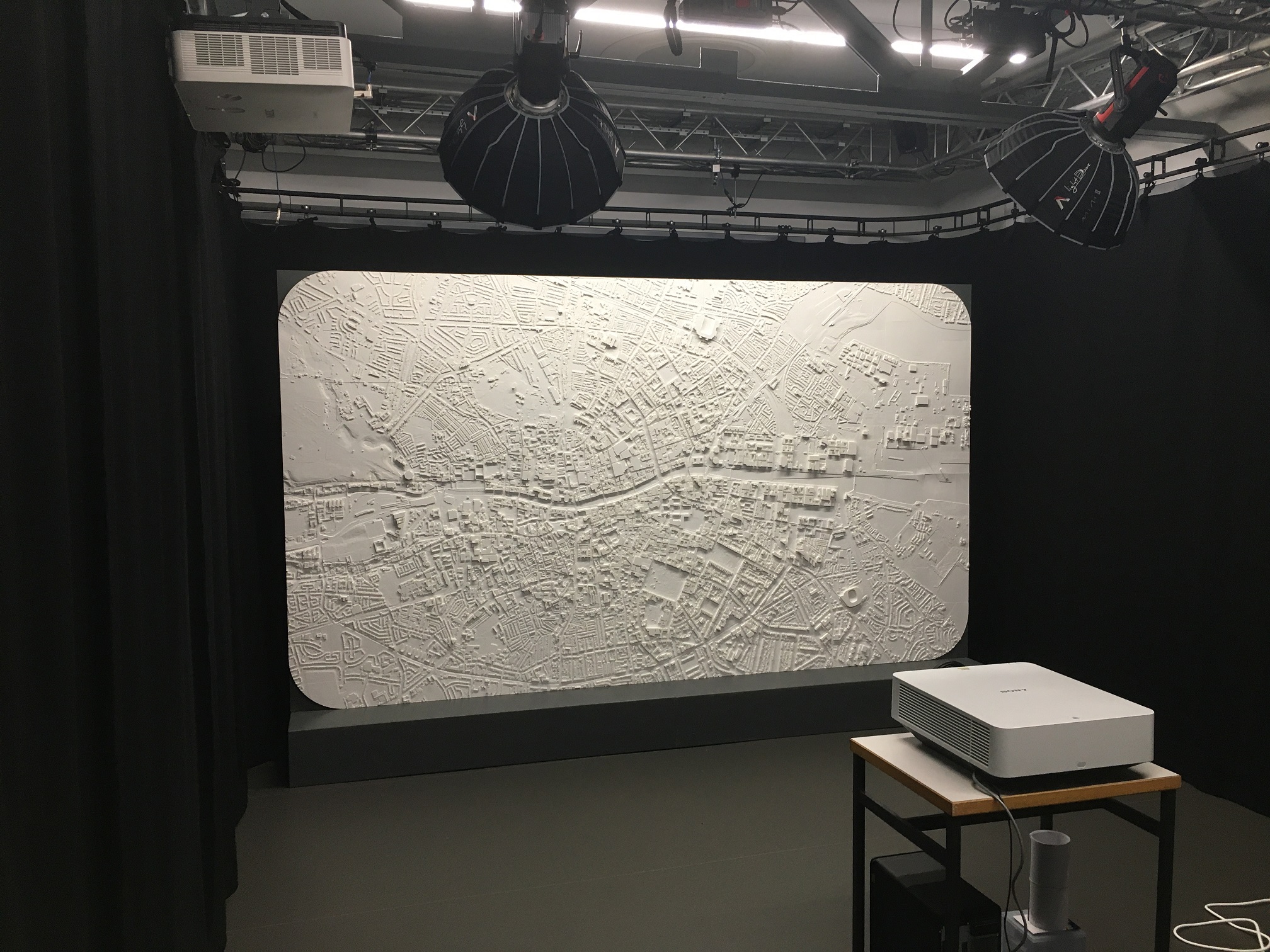
The Data Stories project attended in order to demonstrate the Data City Dublin exhibit as one of the conference’s several practice-based interventions. Data City Dublin is a large-scale 3D printed model of central Dublin which covers 28 sq. km of the city from Phoenix Park in the west to the Dublin Docks in the east. The model is then animated by projected data visualisations representing spatial patterns and change over time.

Excitingly this was the first public exhibition of Data City Dublin. The piece was first created as an end of project exhibition for the Building City Dashboards project. Unfortunately, this wasn’t possible due to the global coronavirus pandemic in 2020. The exhibit is now being used by the Data Stories project as one of several creative and art-based methods for exploring stories about the housing crisis in Ireland through property and planning data.

The Data City Dublin exhibit will continue to evolve as the Data Stories project progresses. On this occasion we displayed several visualisations from the earlier iteration, including eye-catching heat maps of air quality and noise pollution from Dublin’s open data archives. Focusing on our theme of planning and property data, we displayed data from the Inside Airbnb advocacy site representing the distribution of Airbnb properties across the city. This was juxtaposed with distributions of land uses across central Dublin on a building-by-building basis derived from data provided by Tailte Éireann.

New for this exhibit was a time series of orthographic imagery depicting changes in Dublin’s built environment from 1999 through to 2019. Depicting the city in photographic detail in this way enables  us to contextualise the current state of the city by showing how the city changed during the period known as the Celtic Tiger and subsequent financial crash, up until the outbreak of the coronavirus pandemic in 2020.

Supporting the exhibit our Creative Technologist Oliver Dawkins presented a talk ‘Data City Dublin: Grounding Data Through Hybrid Media and Physicalisation’ which contextualised the new work on Data City Dublin in relation to his prior research using sensing devices on the Internet of Things, gaming technologies and augmented and virtual realities to help understand how people interact with buildings and cities in real-world contexts.

New visualisations and data stories will be added to Data City Dublin as the Data Stories project continues to develop. In doing so the team hope it will provide a valuable resource for engaging both professional stakeholders and the wider public with debates in housing, property and planning in creative and exciting new ways. 

Links:


Want to share this? (click + below for more options)

Exploring Social Housing in Dublin

On the 3rd of August, on a surprisingly sunny day amidst this year’s rainy Irish summer, Dáithí Downey, geographer and policy analyst with the National Economic and Social Council (NESC), kindly agreed to lead us on a tour of some of Dublin’s long-standing social housing communities and incoming developments. 

Social housing plays a crucial role in ensuring equitable access to safe and affordable shelter for all members of society. It helps alleviate homelessness, poverty and inequality. It contributes to building inclusive communities, fostering social cohesion and offering individuals and families a foundation from which they can pursue education, employment and a better quality of life. Moreover, investing in social housing demonstrates a commitment to addressing the fundamental human right of adequate housing and promotes a more just and compassionate society. 

The tour began at the Fatima Luas stop and wound around various neighbourhoods in Dublin 8. Stops included the Herberton Development (former Fatima Mansions site), Dolphin House, Donore Project (St. Teresa’s Gardens) and Margaret Kennedy Road. At each of these stops, Dáithí arranged meetings with associated architects and/or community liaison officers. Stefan Lowe (DCC Architects) and Laura O’Gorman (DCC Architects) explained to us how community life was addressed through the construction of social housing.

The Team also met, Laura Kenny (Project Estate Officer for Dublin South Central) and Katarzyna Batraniec (DCC Architects) to discuss their work overseeing ​“rapid-build” volumetric developments near Weaver Park. After, we managed to squeeze in a brief rest stop in Bridgefoot Street Park after spending 3.5 hours on foot, where Dáithí pointed out the completed volumetric developments facing this lively public park. 

As the Data Stories team works on housing and property data, an understanding of social housing is essential for a complete analysis. Social housing data not only offers insights into the well-being of marginalised populations, but also highlights broader societal trends. By examining social housing models, it is possible to measure the effectiveness of government policies, identify housing disparities and assess the impact of urban development on vulnerable communities.

That is why we would like to thank all the individuals who made time (and handouts!) to meet with us and to educate us on the history and future projections for these evolving neighbourhoods and communities. A very special thanks to Dáithí for his bespoke tour and willingness to share his in-depth knowledge of a growing and changing Dublin. 

Want to share this? (click + below for more options)

Data Stories @ Data Journeys

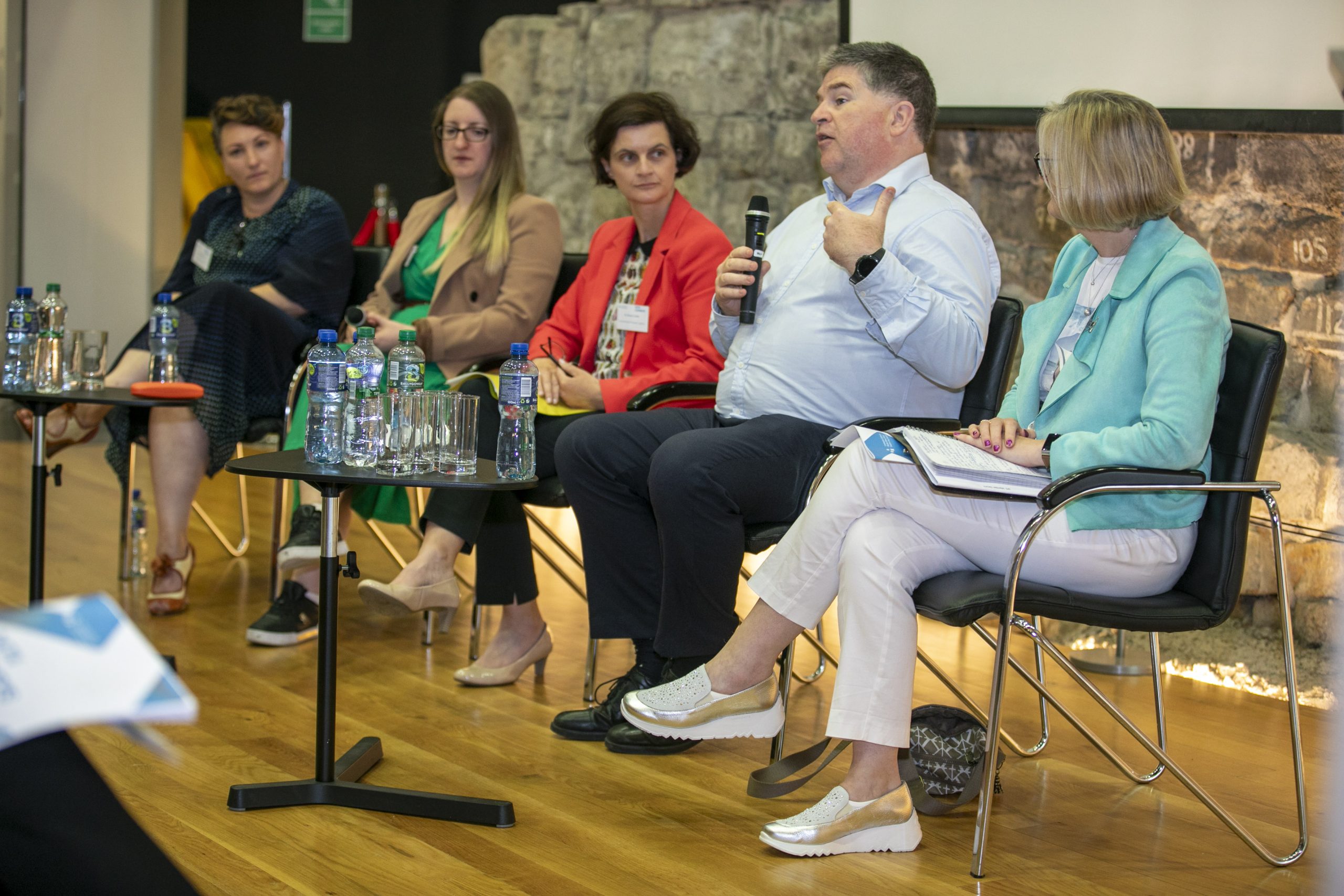
On Wednesday the 12th of July, Professor Rob Kitchin (PI) and Dr. Samuel Mutter (Postdoctoral Researcher) from the Data Stories team attended the half-day ‘Data Journeys’ workshop at Dublin City Council’s Wood Quay Venue. The event, hosted by Angela McCourt of DCC’s Data & Analytics Unit, convened a broad range of public sector bodies from across Ireland to share experiences and knowledge garnered from attempts to improve or enhance data infrastructures and practices within their organisations.

Data Journey Panel

The event featured a series of talks from representatives of bodies including several government departments and local authorities, as well as the Dublin Fire Brigade and the Gardai. The presentations made clear both that different organisations were at different stages of their data journey, and that this journey could not be reduced to a pre-determined, one-size-fits-all approach. Depending on their broader strategic aims, each organisation necessarily plotted their own route, making decisions on what kinds of data were important to them.

Professor Rob Kitchin.

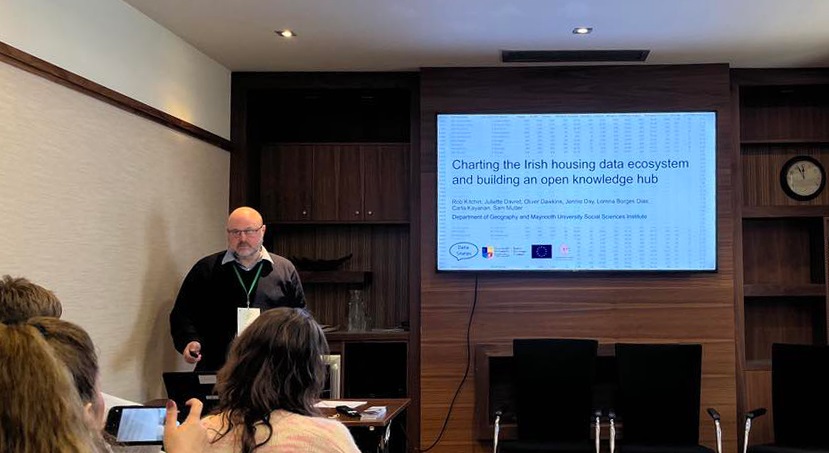
Prof. Kitchin presented a set of initial findings from the Data Stories project. His presentation drew on cases beyond Ireland to demonstrate how data maturity frameworks could be helpful in conceiving of data work strategically, using agreed-upon criteria for data quality whilst also allowing for bespoke journeys which enfold organisational histories, cultures, and operational priorities. In outlining the work of the project to this point, his talk also emphasised the scale of housing, planning and property data alone, within as well as beyond the State.

The Data Stories project generated significant interest among the attendees, with several expressing their desire to discuss collaboration in future work. More broadly, the appetite and enthusiasm for a permanent network to facilitate regular exchange of expertise and provide ongoing support on data-related matters across the Irish public sector was deeply evident as the day drew to a close.

We would like to thank Angela McCourt and their team at DCC for organising the event and inviting us to participate, as well as supplying the photographs for this post.

Want to share this? (click + below for more options)

The Data Stories team takes to the sea

On Thursday, 26 May, the Data Stories team embarked on a boat tour of the Dublin Port. The excursion, organised by James Deery of the National Treasury Management Agency and Maynooth’s Department of History and run by the Dublin Port Company, was an on-the-water seminar discussing the Port’s environmental heritage and sustainability initiatives.

For the Data Stories team, the tour presented an opportunity to see the ongoing construction of the North Lotts and Grand Canal Docks Strategic Development Zone and to view the rapid—though at times stunted—growth of the area from a different vantage point. To get a sense of the planning and development activities that have occurred since the 1980s, when Irish neoliberalism became visible through the built environment of the city, the Data Stories team did a mini-walking tour from Connolly Station to Berth 18, the departure point for the boat tour. The walking tour highlighted key projects on the north side of the Liffey, such as the Custom House Quay building (CHQ), Mayor Square, the convention centre, and the Central Bank. The team then walked along Lower Sheriff Street  to discuss the gradual displacement of the housing complexes that were home for communities who fuelled the economy of the port since as far back as the 1700s. 

The day could not have been any more beautiful for a boat tour. The sun was shining on our way out and the water was still, allowing for a clear, unobstructed and unique perspective of the Dublin docklands. The team will continue to visit various developments throughout the city to gain a deeper understanding of planning and development activity across time, and to complement our growing knowledge of the role the data ecosystem plays in guiding said developments.

Relevant Stories:

Want to share this? (click + below for more options)

Data Stories at the Conference of Irish Geographers 2023

Last week the Data Stories team attended the 54th annual Conference of Irish Geographers (CIG) in Wexford. Members of the team presented in three sessions related to planning and housing over the course of the conference.

Dr. Samuel Mutter and Dr. Carla Maria Kayanan kicked us off with  a paper that used concepts from critical data studies to query the resilience of Dublin’s housing data system, warning of the pitfalls of data being deployed without theory. This paper was part of the session “Questioning the resilience of neoliberal urbanism: Empirical memories, plans, and glitchy urban resilience”.

Dr. Samuel Mutter and Dr. Carla Maria Kayanan.

Next up, Prof. Rob Kitchin presented a paper on charting the Irish housing data ecosystem and building an open knowledge hub in the session “Social movement and research: Housing”. This paper highlighted the value of looking at the data ecosystem to understand and address the housing crisis in Ireland.

Prof. Rob Kitchin

Finally, Creative Technologist Oliver Dawkins presented a paper on social housing data and contested data narratives in the Dublin housing data system for the session “Housing for whom? The future of social housing”. Oliver’s presentation developed the theme of ‘care through data’ focusing on the growing use of data stories in the communication of housing and planning issues.

Oliver Dawkins

Team members Lorena Borges Dias, Dr. Jennie Day and Dr. Juliette Davret also contributed work and ideas for the papers and cheered on the presenters throughout the conference. This was the first time the entire team travelled together to present their work and meet with other geographers from across Ireland and beyond. We would like to thank our session convenors and the wider Geographical Society of Ireland for the success of the CIG conference.

Want to share this? (click + below for more options)

Arts-based methods for researching digital life

Our first Data Stories working paper has been published via the university open access portal.

‘Arts-based methods for researching digital life.’ Data Stories Working Paper 1.

Abstract: This paper provides an overview of the use of arts-based methods for undertaking research on the relationship between digital technologies and society. It first details the approach of research-creation in which research is conducted using of arts-based methods. This is followed by a discussion of specific arts-based methods used in research-creation: creative writing, artistic methods, and creative data stories. Next, it sets out ways in which research undertaken using traditional social science methods can be disseminated in creative ways using creative non-fiction and fiction, film and exhibitions. It closes by noting some critiques of arts-based approaches.

The WP is a draft of a chapter forthcoming in ‘Researching Digital Life’, a book co-authored with James Ash and Agnieszka Leszczynski

PDF: https://mural.maynoothuniversity.ie/16870/

Want to share this? (click + below for more options)

Artists/creative writers in residence posts

The Data Stories project is seeking three artists and creative writers of established reputation to work on the project for a 12 month period.

All three positions run from August 2023 – July 2024, with duties expected to average 3 days a week working on two case studies, each running for six months. We have a broad view of what constitutes an artist or creative writer and will consider applications from the full spectrum of artists, including performance and installation artists and digital and media artists, craft workers, novelists, short story writers, playwrights, poets, cartoonists, essayists, and film and documentary makers.

The work associated with the positions is:

  • To work on two of the assigned Data Stories case studies (scheduled for 6 months each).
  • To aid the research team to produce a data story relating to planning and property in Dublin.
  • To produce at least one data story for each case study through the artist/writer’s own creative practice, drawing on the case study research findings and planning and property data relating to Dublin.
  • To produce at least one data story for each case study in collaboration with a sector stakeholder using a research creation workshop approach. This will involve several meetings with the stakeholder and researchers and running at least two workshops per case study.
  • To help with the artistic direction in public exhibitions of the produced data stories.
  • To document their creative practice on the project work, take part in interviews with the research team about the process of producing data stories, and discuss their experiences and viewpoints at public events relating to the project.

A contract-for-services fee of €32,000 inclusive of expenses is offered for the 12 month period, with €16,000 payable for each case study. Ireland-located candidates will be self-employed persons for tax purposes in Ireland and will be solely responsible for all income tax, PRSI and other such payments due in respect of the remuneration paid. Candidates located overseas will be responsible for all tax matters in their own jurisdiction. All suppliers to Irish public sector bodies must obtain Revenue tax clearance.  All Payment of fees will comply with the University Finance rules.

Payment of fees will comply with the University Finance rules.

For an overview of the Data Stories project see here

The post booklet is available here.

For information on a research-creation approach see Kitchin, R. (2023) Arts-based methods for researching digital life. Data Stories Working Paper 1. https://mural.maynoothuniversity.ie/16870/ (or download PDF direct)

Who may apply:

To be eligible to apply, applicants must have:

  • An established track record of artistic or writing practice, including public exhibitions and published work.
  • A commitment to using creative practice to explore social, political and technical issues.
  • Excellent interpersonal skills and the ability to be an active workshop facilitator.
  • Experience of working collaboratively on creative practices with community members or professional stakeholders.
  • Good project management skills, including an ability to seed, develop and organise work research-creation workshops, manage workloads and timetables, and meet deadlines.
  • Good communication skills and ability to present and discuss their creative practice with the public.
  • Ability to work autonomously and responsibly to meet project goals.

Highly Desirable:

  • Experience of employing a research-creation approach and producing data stories.
  • Experience of reflecting on housing, planning, property issues.
  • Experience of handling and working with planning, property or spatial data more broadly.

Application Procedure

Please note all applications must be made via the MU Online Recruitment Portal at the following link: https://www.maynoothuniversity.ie/human-resources/vacancies

To make an application, artists/writers should provide, within a single document the following information

  • A cover letter explaining: your key achievements to date; why you would like to be considered for the role; your facilitation experiences; and indicative ideas of what you would like to work on (no more than 3 pages).
  • A CV and portfolio of previous works (no more than 15 pages).
  • If you encounter a difficulty with the upload please contact recruitment@mu.ie

The Vacancy ID is 019441.

Key Dates

  • Closing Date: 23.30hrs (local Irish time) on Monday 13th February 2023
  • It is expected that interviews will be held in late February/early March 2023.

Further Information

We will hold an information session on the project and posts where prospective applicants can find out more about the expected work and can ask questions. If you have a specific question email it in advance to rob.kitchin@mu.ie and we will make sure to address in the information session; or post information session send additional queries to the same email address.

Thurs 19th January 11.00am-12.00am (Irish time): On Teams. Click here to join the meeting

The session will be recorded and then shared below, along with terms and conditions of the awards and answers to FAQ. https://datastories.maynoothuniversity.ie/?p=86

For the the slides from the information session click here.

Data Stories Artist Briefing.

Data Stories Artist Q&A.

Terms and conditions

The posts are expected to average 3 days a week of work to undertake the prescribed work. A plan of action and deliverables will be agreed with the project director at the start of each case study and the work will be assessed after 3 months and at the case study close to monitor progress and to evaluate the process, the success of endeavour, and lessons learned. Progress to the second case study will be dependent on successful delivery of the first case study.

Delivery of each case study (six months) has a payment of €16,000 (total €32,000 for two case studies), including expenses (e.g., materials, equipment, consumables, travel). The payment of the fee for each case study will be a third payable on commencement, a third payable half-way through, and a third payable on completion.

The artists and writers will need to interact regularly in person with the research team and with the stakeholders. They do not need to live in Dublin, but must be prepared to visit regularly during the case study fieldwork and to facilitate the workshops.

The project will provide some support for the work undertaken in terms of helping with accessing data and the use of specialist equipment already owned by the project. The organisation costs for the research-creation workshops (e.g., room hire, catering) will be provided by the project. The project will also procure exhibition space for the works produced and help defray publication costs where possible.

The artists and writers will maintain the intellectual and creative rights to the works produced through the commission. Maynooth University and the project will have the right to publish about the commissioned work and the process of working with the artists and writers, to display images of the commissioned work in publications, and to exhibit the works in public exhibitions. In addition, the artists and writers must comply with Article 16 (intellectual property rights) of the EU Annotated Model Grant Agreement (https://ec.europa.eu/info/funding-tenders/opportunities/docs/2021-2027/common/guidance/aga_en.pdf).

Display and publication of the produced works must acknowledge the project funding, including the logos of Maynooth University, the Data Stories project, and the European Research Council and European Union.

The University has the right to terminate the contract due to poor or non-delivery of the case study work.

Selection and Appointment

The applications will be assessed and shortlisted by a panel chosen by the University. Shortlisted applicants will then by invited to interview by the panel.

  • Only shortlisted candidates will be invited to attend for interview;
  • Candidates invited for interview may be asked to provide an expanded portfolio of examples of previous work and will be required to make a brief presentation;
  • Appointments will be approved by the Vice-President for Research or President based on the report of the selection board;

Equality and Diversity

Maynooth University values the enrichment that comes from a diverse community and seeks to promote equality, prevent discrimination and protect the human rights of each individual. To learn more about our commitment to Equality and Diversity, please read the Maynooth University Equality and Diversity Policy. Additionally, as an Athena SWAN Bronze Award Institute, we are committed to advancing gender equality across the University.

We aim to reflect the diversity of the community we serve and welcome applications from all individuals.

Data Protection Law

Maynooth University will process any personal data provided by you in connection with an application for this role in accordance with the General Data Protection Regulation and the Data Protection Acts 2018. If your application is successful and you accept the commission for Maynooth University, then your personal data will continue to be processed in accordance with Maynooth University’s Data Protection provisions. Both the privacy notices and further information relating to data protection, including Maynooth University’s other data protection policies and processes, can be viewed at https://www.maynoothuniversity.ie/data-protection

Want to share this? (click + below for more options)

Work on the Data Stories project: 3 four year postdoc posts

The Data Stories project is seeking three postdoctoral researchers to work on the project. The postdoctoral researchers will work on phase 1 and 2 of the project and will principally undertake the research for four case studies, including their preparation, fieldwork, analysis, and creation of their associated data stories, including coordination with the assigned creative writer/artist, as well aiding the organisation of exhibitions, and archiving and documenting the project. They will have experience of handling administrative datasets, using a variety of qualitative methods, and preferably familiarity with creative and artistic methods.

At least two of the postdoctoral researchers will have research experience in Human Geography, Urban Studies, or Planning. One post will preferably have research experience in Critical Data Studies, STS, Media Studies, Art and Design or related disciplines.

For an overview of the Data Stories project see here

Full details of the posts are in Job Spec booklet

The ideal candidate will have:

Essential:

  • Either a PhD in Human Geography, Urban Studies, or Planning, or in Art and Design, Critical Data Studies, STS, Media Studies, or related disciplines.
  • Strong working knowledge of planning, property, and housing issues and its underlying evidence base, or of data practices, policies and infrastructures within state, business and civil society organisations.
  • A good working knowledge of handling and using administrative data, spatial data and databases.
  • A deep knowledge and experience of using qualitative methods, particularly undertaking ethnographies, interviews, and focus groups, and analysing the data generated.
  • Excellent interpersonal skills and experience of working collaboratively in research teams and with external stakeholders.
  • A willingness to work undertake interdisciplinary research and learn new knowledge and skills.
  • Good project management skills, an ability to coordinate four case studies with stakeholders and to contribute to organisation of workshops, seminars, and exhibitions.
  • Ability to work with a degree of autonomy, manage workloads, deadlines, and responsibilities.
  • A record of scholarly work and publication of international quality, appropriate to career stage.
  • Excellent writing and presentation skills in English.

Desirable:

  • Using and devising creative methods, such as creative writing, artistic methods, documentary film–making or live performance.
  • Experience of working with artists and writers, or undertaking participatory practice, such as participatory GIS or citizen science.
  • Experience of producing data stories and using interactive data visualisation.
  • Experience of archiving data in an open repository.
  • An ability to present research findings at international conferences.
  • An ability to communicate effectively with non–academic audiences.


Application Procedure

Applications must be submitted online via the Maynooth University vacancy portal https://www.maynoothuniversity.ie/human-resources/vacancies

Key Dates

Closing Date: 23.30hrs (local Irish time) on 1st November 2022

Anticipated Start Date: 1st February

Further Information

Further information about the role including application procedure should be obtained from the Maynooth University vacancies website https://www.maynoothuniversity.ie/human-resources/vacancies

Informal enquiries may be directed to Prof. Rob Kitchin: rob.kitchin@mu.ie

The project has received funding from the European Research Council (ERC) under the European Union’s Horizon Europe research and innovation programme Grant Agreement No. 101052998


Want to share this? (click + below for more options)

Welcome to the Data Stories project

Funded through an ERC Advanced award to Professor Rob Kitchin (grant no. 101052998) the Data Stories project started on August 1st 2022 and will run for 5 years. The project is focused on data ecosystem, politics, praxes and power operating within the planning and property domains, and telling stories about and with planning and property data. More information is on the About page and this video provides a brief explanation:

The project is presently recruiting its first staff and will eventually employ a creative technologist, 3 postdocs, 2 or 3 creative writers, 2 or 3 artists, and an assistant lecturer/researcher. The team will work closely with stakeholders from government, business and civil society organisations and their staff, and will engage with the public through workshops, exhibitions, this website and the resources it will host, and social media. At present, the project has a Twitter account: @datastoriesMU

Want to share this? (click + below for more options)