All posts by Oliver Dawkins

Mapping data and diverse knowledges: stakeholder workshops on the relationship between evidence and policy

Authors: Carla Maria Kayanan and Joan Somers Donnelly

In April and May, Joan Somers Donnelly and Carla Maria Kayanan conducted two workshops under the umbrella theme Housing Data: Evidence and Policy in Planning and Housing. The theme of the workshop emerged from a set of interviews conducted with key stakeholders to discuss the past roll out of the Housing Need and Demand Assessment (HNDA) and to consider the future of this National Policy Objective. To better inform our understanding of the logics underpinning the HNDA—and housing policy more broadly—Joan and Carla decided to create a space where housing policy stakeholders could collectively think through the role of evidence and evidence-based tools. The workshops were split into two themes: 1) Where are we now? 2) Where do we want to be? Participants predominantly came from government, planning and policy, but individuals representing the civic and business sectors were also in attendance.

First Workshop

In the first workshop, participants engaged in several visual mapping exercises. Taking an example of a substantial piece of policy work they were currently working on or had recently finished, they worked individually to create maps of the different knowledge, information and evidence needed to do that piece of work. This included labelling index cards to indicate their sources and who or what helps them interpret and connect things. They then created a second map illustrating the relationships between the key knowledge/information/evidence points and relevant stakeholders identified on the first map, using a series of objects to convey the various connections, disconnections and gaps (see top image).

In the third exercise, participants placed their index cards from the first map onto a large map on the ground, in accordance with the stage in the process where they used that knowledge/information/evidence. The map was fashioned in a form of concentric squares identifying the following stages: 1) key to understanding situation, 2) helps identify policy approaches, 3) helps form policy/drive decision making, 4) helps refine policy/numbers, 5) supports policy decision. They then connected the second maps they created as satellites to the third map. These acted to zoom in on some of the details of the dynamics at play in the use of evidence in policy making. Observations about the visual characteristics and structural elements of the maps served as a starting point for a group discussion at the end of the workshop.

In the days after the workshop, participants were invited to a short online interview to discuss the logics behind their maps. These discussions were highly informative. Of particular interest were the descriptions of the objects used to demonstrate relationships. Among many other things there was a snail shell to demonstrate movement at a ‘snail’s pace’, a hand massager to demonstrate who does the coaxing and who receives the massage, and a carabiner to demonstrate the way that data gets ‘locked’ within certain people and institutions. It was particularly interesting to notice what was not appearing on the maps. Often, this was experiential and sectoral knowledge, as well as local knowledge and insights, that are used to interpret the evidence. These elements were acknowledged in the room during the workshop discussion, but when people were discussing the structure of how they work with different kinds of evidence, this information was not incorporated as part of the analysis, remaining unexamined and taken for granted as part of the process. This suggests a lack of acknowledgement of the positionality of different agencies and that positionality’s influence on the interpretation of data, and the lack of structural ways to integrate qualitative data and other localised forms of knowledge.

Second Workshop

The second workshop built on reflections gleaned from the first workshop and ensuing post-workshop discussions. Whereas in the first workshop participants spent time mapping out their own working processes, the second workshop focused on higher level reflection on how the different stakeholders see and use evidence in their work, and the dynamics of the environments that shape those data practices, with more time working and exchanging in pairs and in small groups. The first exercise included responding to reflective questions about their relationship to their work and attitudes towards data and evidence through quick drawings that were later discussed in pairs. The second exercise entailed contributing phrases and drawings to circular diagrams to indicate which things should be feeding into each other that are not currently (e.g. what should feed into the creation of data sets, what should feed into the interpretation of evidence), and the work needed to bridge those gaps.   

In the final exercise participants worked in small groups to discuss a quote highlighting an issue raised in the first workshop or the post-workshop interviews. In small groups, participants were asked to create a fictional physical landscape with characteristics that represented the environment that the issue or dynamic emerged or existed in. The three quotes under analysis were:  

1) ‘The data government are using is sometimes thrown at the public or communities as a justification for making decisions’ 

2) ‘Has it changed anything on the ground though?’ We are changing some of the methodologies, but has the way people are thinking about the problems changed?    

3) ‘We’re not necessarily looking at the softer information, insights about what the trends in the data are about. We’re not feeding those insights into things in a structural way’ 

Participants then presented the story of these fictional landscapes, including physically illustrating a shift that could occur in that landscape.

‘’There happens to be 32 pieces of confetti under here…’’ 

Reflections from the workshop are ongoing. For the purpose of this blog, we categorise them here along three themes: methods, planning and policy thinking and engaging artistic methodologies.

Data practices   

As demonstrated from the overlapping number of cards placed in the centre circle in the group mapping exercise in the first workshop, there was a consensus that a lack of data is not the problem, but rather that there is an overwhelming amount of data. The identified ‘gap’ is the ability to parse, clean, analyse and apply the data. Therefore, the data is ‘out there’ but, to use the words of the participants, it gets crowded, locked (in a person, a place or an organisation) or left behind through continuous advancement in policy making.   

According to the participants, data’s use depends on relationships, communications and people. Different people use their frames of expertise to understand the data and to place assumptions on the data as part of an evidence-base. These ‘political manipulations’ can alter policy in such a way that the evidence-base is not apparent, but obscure. Yet, some expressed that people are the richest sources of evidence. Not only due to their ability to ‘unlock’ connections, but also because people are ‘living data.’ In the aggregate, they make up the public that the government is meant to serve. The challenge is widely understood to be converting public voices, the anecdotal, and other forms of bottom-up qualitative material into an approved evidence-base that can underpin policy. This raises the question around how to map these knowledges that are in some cases implicit and not being critically examined, or in other cases not being considered or integrated at all. Our hope is that using artistic methodologies in these workshops is one avenue to ‘see’ data flows and data practices through moulded clay, data and knowledge flow maps, objects as metaphors and landscapes in need of intervention.

Planning and policy: Reflective practitioners   

One undercurrent theme that emerged from the exercises that could further understanding on issues identified with data practices relates to planning and policy epistemologies, that is, the form of thinking that is most closely associated with professionals in planning and policy making. Government is large, bureaucratic and hierarchical. Practitioners, reflecting this structure, become entrenched in a pragmatic and process-oriented way of thinking. Factors that contribute to this are the need to be result-driven and the necessity to deliver on policies that are statutorily underpinned (i.e. already decided for them, leaving little to no power and/or flexibility). In the literature, planning and policy professions—along with social workers and administrators—are often critiqued for being apolitical. A linear form of thinking is required to complete tasks, ultimately reducing criticality.    

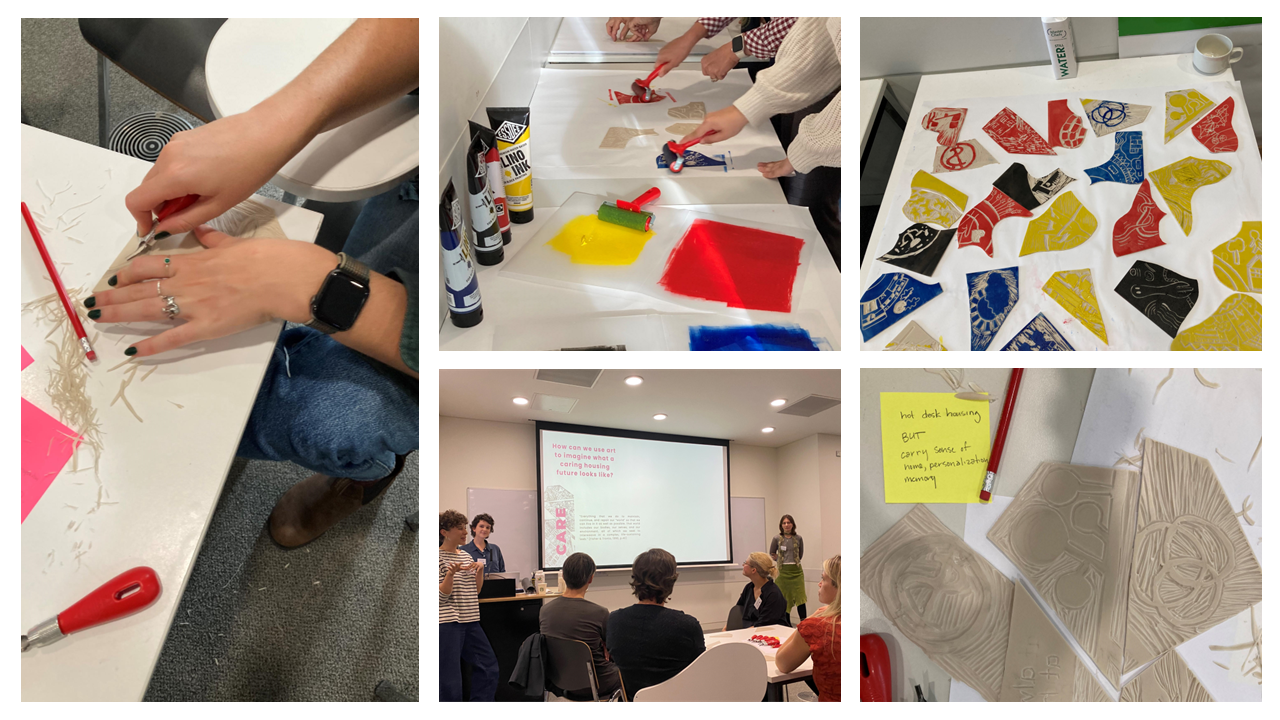
In a warm up at the start of the first workshop, participants were asked to team up with someone. Each holding a piece of clay, one participant spoke uninterrupted about their embodied experience of the various stages of a recent decision they had had to make at work, including the pressure they felt from different directions, while the other listened. After ten minutes, roles were reversed. In both instances of being a speaker and a listener, participants moulded a piece of clay.

In post-workshop conversations, this exercise elicited the most comments in that participants were surprised by how much they enjoyed the exercise. While many initially thought it would be outside of their comfort zone, they expressed that it was very worthwhile to get an insight into someone else’s way of thinking and approaches to the complexity of this work, processes that normally remain internal and are not often exchanged on in this manner.   

What is needed, as Donald Schön (1983) writes, is a ‘reflective practitioner’ who has the time and freedom to step outside of the daily practices that shape pragmatic thinking and enter a space of reflection (see here for a short video, focusing on teachers). The internal dialogue that occurs between daily ‘doing’ and reflection on actions being taken is the crux of change-making. Data is always and already advancing and in flux. Similarly, policies are continuously changing to remain relevant. One need only think of the shift to e-planning, the creation of Tailte Éireann, the Planning and Development Bill 2023, to name a few. Changes will go on in the attempt to match the pace of technological innovation. However, reflection time is critical. This is as important for the administrators on-the-ground who make and handle the data on a daily basis as for executives who make decisions on how and where data will flow.

Artistic Methodologies in Research   

As the artist working on a case study initially focused on the HNDA, Joan was closely involved in the earlier, more traditional interview process with Carla, which gave her an insight into data flows and practices at different scales of government and the existing issues and challenges. At the inception of the case study the focus was on the HNDA, so interviews were geared towards developing a workshop around that topic. The more we learned and immersed ourselves, the more we realised the challenge of tackling such a specific topic from the outside. For the workshops we decided to focus instead on issues around data and data practices that came up in the interviews but seemed to be present more broadly in the ecosystem, particularly around different kinds of evidence and their interpretation. We decided to invite a broader set of stakeholders to engage in our continued research process in a more interactive way. 

The workshops were an interesting introduction to all (including us as organisers) to using artistic methods to analyse and reflect on data practices in policy-making. Valuable insights emerged from both workshops, demonstrating the potential of arts-based methods as a frame to facilitate exchange among a diverse group of stakeholders. These methods can provide a route into a different mode of thinking and interacting, allowing different thoughts and connections to rise to the surface compared to what comes up in day-to-day work processes or traditional research interviews. This different lens through which to reflect, and the playful setting that allowed participants to take off their ‘professional hat,’ as one person put it, was widely appreciated by all.

One embedded component of Data Stories is to ‘test’ the effectiveness of research creation. To engage with the full potential of the concept of research creation, whereby new knowledge applicable to social science (in this case) and in turn to policy makers would be produced through a collaborative two-way process between the artist and researcher team and stakeholders, there would need to be a sustained commitment from all sides to a longer-term, open-ended process. While many participants expressed that they were somewhat sceptical at the beginning of the workshops, the methodologies and forms of engagement were more warmly received in the end than we had expected, proving a positive testing of the water around creative research methods.  

The lack of familiarity with these processes and the uncertainty of the outputs though, as well as the time needed to digest artistic processes and to facilitate co-creation, might limit the commitment that can come from policy makers on an institutional level to engage in more in-depth interdisciplinary processes that could ultimately have much more impact on ways of thinking and working. However, the curiosity and openness of many individuals indicates potential for smaller scales of  engagement in the sector that could serve as a step in that direction. Joan is currently continuing to engage one-on-one with planners, extending invitations to meet in their local authority areas to reflect and exchange on the relationship between evidence, local knowledge and the role of imagination in planning and public consultation, using artistic methodologies. These meetings will form the basis of a kind of experimental ethnography, looking at the specific position and role of planners in the ecosystem and its challenges and possibilities. 

Going through an artistic process is very different from the thinking and working processes of the stakeholders we were working with. It involves doing things that do not seem ‘productive,’ such as reflecting on elements of subjective experience, translating things between media, reading literary or philosophical texts, and generally approaching things from a different angle. This associative and more oblique way of working through things is something that stakeholders working in the highly pressured world of policy making could benefit from having the time to engage with, but the fact that it is so different is also what makes it hard to get people on board – it takes time, asks people to step out of their comfort zone, and is open-ended (there may not be a clear goal, or it needs to be defined during the process). This still seems like a big leap to take in this sector. Bureaucracy in Ireland is strong. Further, the system of governance in place challenges autonomy and power at lower scales. If the sector were more open and less results focused, would research creation become one pathway for change, through the shifting of perspectives and creation of space for collaborative thinking? While the reaction within government and bureaucracy to a challenging political and economic climate is often to increase control and centralisation, much research suggests that other approaches are needed: 

“Indeed, it could be argued that the focus on building the capacity for instrumental rationality — so as to secure specified outcomes and targets — risks actually reducing the capacity for flexibility, innovation and adaptability which is vital for policy-making in a runaway and uncertain world.” (Parsons 2004 p 48) 

Collaborations between the arts and government/policy making are challenging because of how different the outlooks and approaches are, but therein also lies their potential.

For more on Joan’s work see her website or Instagram. If you work in planning and would be interested in taking part in the research on the role of planners in the data ecosystem you can get in touch at joan.somersdonnelly@mu.ie.

References

Parsons, W. (2004). Not just steering but weaving: Relevant knowledge and the craft of building policy capacity and coherence. Australian journal of public administration, 63(1), 43-57.

Schön, D. (1983) The Reflective Practitioner. How professionals think in action, London: Temple Smith.

Want to share this? (click + below for more options)

Library Services for Housing and Planning Publications in Ireland

Library Services for Housing and Planning Publication in Ireland

The second Data Stories working paper has been published authored by Rob Kitchin and Anne Murphy. The paper reports the findings of a workshop co-organised by the Data Stories project and the Housing Agency which examined the archiving of housing and planning literature – reports, policy documents, departmental circulars, legislation, academic papers, books – related to Ireland. At present, published material is scattered across many sites, can be difficult to locate and source, and many documents are vulnerable to being lost as they lack permanent links. The report details existing library resources and their scope and remit, examines the need for a centralised housing and planning publications hub that will collate, catalogue and provide public access to archived material, and considers how such a hub might be produced and maintained.

The working paper is available through MURAL, the university’s open access repository.

Kitchin, R. and Murphy, A. (2024) Library Services for Housing and Planning Publications in Ireland. Data Stories Working Paper 2, Maynooth University Social Sciences Institute.


Want to share this? (click + below for more options)

INTERSECT visiting research fellow – University of Copenhagen

Juliette Davret has recently been awarded the INTERSECT Visiting Research Fellowship at the University of Copenhagen  

INTERSECT is an academic community led by Kristin Veel and Henriette Steiner for interdisciplinary collaboration at the intersection of the arts, humanities, social sciences, and design. This knowledge hub combines research on cities, landscapes and communities with questions of inequality and justice. The space offers the possibility of developing new ways of identifying and discussing slippery problems that are difficult to measure, inviting a wide range of methodologies ranging from artistic practice-based approaches to data-driven GIS methods.  

Juliette spent three weeks in April 2024 at the Department of Arts and Cultural Studies of the University of Copenhagen, under the supervision of Kristin Veel. She took the opportunity to present her work during a CIRCLE seminar. Her presentation focused on the research-creation aspect of the Data Stories project. Juliette discussed how the use of research-creation encourages exploration, experimentation, play and improvisation. It creates a sense of estrangement and de-familiarisation to generate critical reflection and enables surfacing knowledge that is not easily expressed with words. Indeed, through phase 2 of the Data Stories project, Juliette is collaborating with two artists in residence, working with research-creation methods on two different case studies. She described the work she has done involving research-creation, in particular how, in collaboration with the artist Mel Galley, she has been using speculative fiction to encourage stakeholders to reflect on their use of data , and how, in collaboration with the artist Joan Somers Donnelly as part of a second case study, she has employed creative mapping exercises to reflect on the relationships that link and build the data ecosystem. She has been able to share her reflections with an audience that uses and facilitates research-creation. The discussion focused on the challenges faced by research projects in using research-creation methods.

Juliette Davret

Juliette made the most of the fellowship by establishing strong links with the Digital Culture Cluster community and discovering research overlaps with the DATALOSS project held by Nanna Bonde Thylstrup. She also benefited from the visit of other researchers in the same group, attending the keynote lecture given by Prof. Orit Halpern (Technische Universität Dresden) about ‘Financializing Intelligence’ – this research traces the relationship between neoliberal thought and neural networks. She took part in the workshop on ‘Digital Humanitarianism’ held by Prof. Fleur Johns (Sydney Law School). Finally, she participated in the ‘Critical Data & AI Lecture Series #4’ given by Amir Anwar (University of Edinburgh) about ‘Reimagining networks and geographies of AI and Machine Learning’.   

This first stay was very interesting and beneficial for the development of research-creation thinking and demonstrates the interest in developing new collaborations at the intersection of the arts, humanities and digital technologies to strengthen the involvement of stakeholders and citizens in planning practices and advocate for more liveable cities. Juliette is looking forward to returning to the Department of Arts and Cultural Studies at the University of Copenhagen in autumn 2024.   

Grant:

Davret, J. (2024) INTERSECT Visiting research fellowship. University of Copenhagen. 10,000 DK.


Want to share this? (click + below for more options)

Reinventing the City – AMS Scientific Conference

Juliette Davret, postdoctoral researcher within Data Stories project, took part in the AMS Scientific Conference from 23 to 25 April 2024. In the second edition of “Reinventing the City”, the overarching theme was “Blueprints for messy cities? Navigating the interplay of order and messiness”. In three captivating days, they explored ‘The good, the bad, and the ugly’, ‘Amazing discoveries’ and ‘We are the city’.

AMS Scientific Conference Banner

DAY 1: THE GOOD, THE BAD AND THE UGLY  

The first day of the AMS Scientific Conference primarily focused on messiness: the various aspects of urban development and innovation. “The good” refers to success stories and positive developments in cities. “The bad” relates to challenges and issues that cities face, and “the ugly” pertains to less attractive aspects of urban development. This theme explored how cities, both in terms of space and users, are evolving in positive and negative ways.  

On this first day, Juliette presented a paper entitled “Counting matters, but how we count matters too: considering the spatial and data politics of homelessness”. Building upon the insightful work of Cobham (2020), which underscores the significance of what we count, this paper argues that the methods employed in counting are just as crucial. As demonstrated by Cobham (2020), policies and decisions are underpinned by evidential data; thus, being excluded from these datasets equates to being overlooked. This paper delves into the analysis of homelessness counts and considerations in Ireland, aiming to illustrate how counting methodologies lead to significant underestimations of the homeless population. Utilizing a critical data approached combined with interviews of state and NGO stakeholders, this paper seeks to document and reconsider the political, social and spatial implications of homelessness data flows and their implications for homelessness and housing policies. In the context of digitization, it highlights the data politics of administering homeless services, inaccessibility of census services, the lack of coordination among data-collection organizations and financial and resource constraints that contribute to fragmented efforts and the underrepresentation of the most marginalized populations. The paper contends that achieving a more comprehensive understanding of homelessness is essential for informing effective policies and interventions to address this humanitarian crisis. By exploring the intricacies of counting methodologies and their impact, it aims to contribute to the ongoing discourse on the importance of robust data collection in shaping policies that truly reflect the realities of homelessness.

This paper was presented during a session on ‘Data for Inclusivity’ in which participants discussed the lack of certain datasets to support city governance. 

DAY 2: AMAZING DISCOVERIES  

The second day of the conference concentrated on pioneering research and innovations, both technical and social in the field of urban renewal and sustainability. Participants presented and discussed news and exciting discoveries that have a positive impact on urban areas. The focus was on areas such as mobility, food, circularity, energy, climate resilience, and smart city.

DAY 3: WE ARE THE CITY 

This theme emphasised that the people living and working in cities play an essential role in urban renewal and development. This can involve community engagement, citizen participation, public-private partnerships, and the importance of involving all stakeholders in the city.  

On the final day, Juliette presented a paper entitled “The role of citizens in the urban planning process: power and inequality through the analysis of data flows”. This presentation discussed how the digitalization of the planning process can potentially improve stakeholders’ involvement. Indeed, digital tools potentially improve interaction between planners and citizens, reduce barriers to participation, encouraging creativity and expression. However, this can only be an improvement if citizens are able to participate effectively. As Rosener (2008) has shown, it is not enough to evaluate the success of participation based on more citizens taking part, but rather its impact, to achieve better public policy. This study examines the challenges faced by citizens in actively participating in the planning process in the digital age through an ethnographic approach of a citizens’ association in Dublin. Specifically, this paper investigates how citizens strive to gather and mobilize data and integrate themselves into the planning system to voice their opinions, particularly during the planning appeals stage. In the context of the increasing digitization of the planning process, this paper scrutinizes the data flow within the system and its implications for citizen interaction within the planning and building control process. Additionally, this research examines how citizens leverage data to pursue collective or personal goals, probing the extent of their influence on the planning process. By demonstrating the significance of citizen engagement, this makes it possible to assess its impact on transparency and accountability, shedding light on biases in participation. The paper discusses power inequalities within the planning process, underscoring that only a minority of citizens familiar with the process are actively involved. This analysis encourages reflection on open data and transparency on the generation, flow, and analysis of planning data, and how citizen participation can be enhanced and equitably distributed in the age of digitized urban planning.

This paper was presented during a session on ‘Digital Tools for Cities (Digitalization)’ in which participants presented different tools to improve the digitalization of urban planning or to reflect on the challenges of digitalization.

Conference website: https://reinventingthecity24.dryfta.com/ 

References:

Cobham, A., 2020. The uncounted. Polity press, Cambridge Medford, Mass. 

Rosener, J. B. (2008). Citizen Participation: Can We Measure Its Effectiveness? In The Age of Direct Citizen Participation. Routledge. 


Want to share this? (click + below for more options)

Call For Papers (3/3) – Critical perspectives on planning and housing data (IGC 2024)

This is the third of three calls for papers from the Data Stories team for the next International Geographical Congress (IGC) in 2024. 

IGC 2024 is an international conference bringing together geographers from all fields, from the social sciences to physical geography and beyond. The theme for 2024 is “Celebrating a world of difference”, for which 44 different commissions are proposing sessions. The IGC 2024 will be held in Dublin from August 24 to 30: https://igc2024dublin.org/ 

CFP Critical perspectives on planning and housing data  

Dr. Carla Maria Kayanan (chair), Dr. Juliette Davret, Prof. Rob Kitchin, Dr. Sophia Maalsen, Dr. Samuel Mutter and Dr. Maedhbh Nic Lochlainn are organising a session on critical perspectives on planning and housing data.  

Session abstract: Planning and property data are the key evidence base for how cities are understood, planned and developed (e.g., Kitchin, 2021; Loukissas, 2019; Marquarts, 2026; Meng and DiSalvo, 2018). The increased use of data in urban planning, housing management and development financialisation has led to profound shifts in how we understand, design, and manage our built environments. However, this transition towards a more data-driven approach raises a series of critical questions concerning who controls the data infrastructures, the generation, analysis, and interpretation of data, and data-driven decision-making, as well as issues of spatial justice, privacy, representativeness and data ethics. 

This session aims to examine the most crucial and contentious aspects of data politics and power in urban planning and housing management. We seek contributions that explore critical perspectives on planning and housing data, including but not limited to the following topics: 

  • Data infrastructures of planning and housing; 
  • Data utilization in addressing housing crises;  
  • Data capitalism and housing financialisation 
  • Biases and inequalities in housing and urban data; 
  • Activist uses of planning and housing data 
  • The impact of automation and artificial intelligence on urban planning; 
  • Ethical and privacy issues in planning and housing data practices; 
  • Visual narrative and other representations of data in urban planning; 
  • Historical perspectives on data in urban planning and housing; 
  • Challenges of public participation in a data-centric context; 
  • New methodologies for critically analysing data in urban planning. 

Critical Perspectives on Planning and Housing Data CFP Banner

The deadline for abstract submission is on 12th January 2024. Abstract submissions must be made via the conference website. Details on submitting can be found here: https://igc2024dublin.org/call-for-abstracts/ 

The Congress Commission for this abstract is C.42 Urban Commission. Ensure you make clear you are submitting for this session when submitting your abstract. 

Please direct questions to session chair: Carla.Kayanan@mu.ie  

See our two other blog posts for calls for papers for the pre-event and the IGC conference. 

Links: 

Want to share this? (click + below for more options)

Call For Papers (2/3) – The digital turn in planning practices and policy making (IGC 2024)

This is the second of three calls for papers from the Data Stories team for the next International Geographical Congress (IGC) in 2024. 

IGC 2024 is an international conference bringing together geographers from all fields, from the social sciences to physical geography and beyond. The theme for 2024 is “Celebrating a world of difference”, for which 44 different commissions are proposing sessions. The IGC 2024 will be held in Dublin from August 24 to 30: https://igc2024dublin.org/ 

CFP The digital turn in planning practices and policy making  

Dr. Juliette Davret (chair), Oliver Dawkins, Dr. Carla Maria Kayanan and Prof. Rob Kitchin are organising a session on the use of the digital in planning and policymaking.  

Session abstract: Planning has long used digital tools such as GIS and decision-support systems. Yet, much of the practice of planning has remained paper-based. In recent years, a concerted effort to digitalise planning has occurred, shifting all aspects of planning (from strategic, to development, to enforcement) onto an amalgam of data infrastructures and systems. This digital turn is altering the day-to-day work of planners, shifting external body engagement, enabling wider access to information, raising questions about the public’s proficiency and ability to engage, and enabling new data flows (Daniel & Pettit, 2021; Willow & Tewdwr-Jones, 2020). The change management introduced by the adoption of digitally-mediated planning is not straightforward and is complicated by the multiplicity of sectors, stakeholders, data systems and flows intersecting through different stages of planning processes. 

This session explores the impact of digitalisation on the field of planning (Potts, 2020; Datta, 2023). We seek papers that shed light on innovative approaches, challenges and opportunities presented by the digitalisation of planning whilst also implementing a critical lens (e.g., critical data studies, critical geography, critical planning studies, STS, etc.).  

Topics include (but are not limited to): 

  • Digital change management of planning systems and practices; 
  • Planning’s data infrastructures and data ecosystem; 
  • Smart cities and urban planning;
  • Data-driven decision making; 
  • Geographic Information Systems (GIS) in planning; 
  • Emerging technologies in planning development; 
  • Sustainable and resilient infrastructure planning; 
  • Community engagement in the digital age; 
  • Policy implications and ethical considerations of digital planning; 
  • Data policy in digital planning. 

Researchers and practitioners are invited to submit abstracts. 

The Digital Turn in Planning CFP Banner

The deadline for submitting an abstract is on 12th January 2024. Abstract submissions must be made via the conference website. Details on submitting can be found here: https://igc2024dublin.org/call-for-abstracts/ 

The Congress Commission for this abstract is C.31 Local and Regional Development. Ensure you make clear you are submitting for this session when submitting your abstract. 

Please direct questions to session chair: Juliette.Davret@mu.ie 

See our two other blog posts for calls for papers for the pre-event and the IGC conference. 

Links: 

Want to share this? (click + below for more options)

Call For Papers (1/3) – Reimagining local governance: Just, sustainable and diverse (IGC 2024)

This is the first of three calls for papers from the Data Stories team for the next International Geographical Congress (IGC) in 2024.

IGC 2024 is an international conference bringing together geographers from all fields, from the social sciences to physical geography and beyond. The theme for 2024 is “Celebrating a world of difference”, for which 44 different commissions are proposing sessions. The IGC 2024 will be held in Dublin from August 24 to 30: https://igc2024dublin.org/ 

Pre-IGC CFP (23-24 August) 

Prior to the official start of the congress, the IGU Commission Geography of Governance is hosting a free two-day conference on the topic ‘Reimagining local governance: Just, sustainable and diverse’. The event will take place on our Maynooth Campus with Dr. Carla Maria Kayanan as co-conference convener and head of the Local Organising Commission.

IGU Commission Geography of Governance Conference Banner


Three tracks will shape the event: 

  • Track 1 – Territorial Reforms, Multi-level Governance, and Democracy 
  • Track 2 – Sustainability, Resilience and Justice in Local Governance 
  • Track 3 – Spatial Planning Systems and Local Governance

For more information and to submit an abstract, visit: https://sites.google.com/view/geogov2024/home  

See our two other blog posts for calls for papers for the week-long IGC.

Links: 


Want to share this? (click + below for more options)

Data City Dublin at Beta Festival 2023

This November saw the introduction of a new festival of art and technology on Dublin’s annual arts calendar: Beta Festival. The festival programme centered around a free two-and-a-half-week exhibition running from the 2nd to the 19th of November at the Digital Hub in Dublin’s Liberties. The Data Stories team were pleased to be invited to exhibit Data City Dublin for the festival’s opening and first weekend.

The purpose of Data City Dublin is to collect and present evidence regarding Dublin’s housing crisis in a public forum, and to stimulate debate. Combining a large 3D printed model with projected data overlays, the exhibit seeks to bridge the gap between official accounts of housing, planning and property issues and the individual experiences of the city’s inhabitants. While searching the surface of the model for points of interest such as schools, homes and workplaces, visitors are encouraged to share their stories and experiences with each other. In this way the model provides a tangible reference linking spatially located data to personal narrative via their association with familiar places across the city, here represented in miniature.

Visitors search Data City Dublin

Data City Dublin Discussion

News Headlines

A new element introduced especially for Beta Festival was the incorporation of news headlines concerning housing, planning, and property stories from the past twenty years. Borrowing the concept from Jeneen Naji’s work River Poem, this stream of news headlines was projected floating down the River Liffey and out to sea. By revisiting the diverse range of opinions, reactions, and speculations represented by these headlines, visitors were prompted to reflect on the events leading to the current housing crisis and encouraged to consider alternative approaches for the future.

Data City Website on Mobile Phone  

Accompanying the exhibit was a dedicated website which provided further information about each of the datasets being projected onto the model. Access to the website was exclusive to Beta Festival visitors who could access them by scanning QR code on their mobile phones. Data City Dublin was just one of many exhibits including photographic images, films and computer animations, installations, an interactive AI chatbot and a large central 360-degree immersive space. However, measuring 3.5 x 2 metres, the 3D printed model and vivid data overlays comprising Data City Dublin provided a strong physical and visual presence in the space.  

Data City Dublin’s appearance in the festival aligned well with Beta’s overarching themes of critically engagement with emerging technologies and interrogation of their societal impact. Emphasising values of collaboration, integrity, empowerment and curiosity, Beta provided an ideal forum for a work like Data City Dublin which combines novel uses of technology with critical research. With a five-year commitment from The Digital Hub to host the festival we look forward to it becoming a key event for future explorations of the crossover between art and technology.

Links:

Want to share this? (click + below for more options)

Data Stories and Arts-based Methods: Introducing the Artists

We’re pleased and excited to introduce the first cohort of artists to join the Data Stories team. Joan Somers Donnelly, Mel Galley and Augustine O’Donoghue will be helping the team to explore arts-based methods as a means for research-creation. Typically, arts-based methods are integrated into research projects toward their conclusion to communicate findings to the public in novel ways.

What makes this method stand out is that, with the integration of our artists and their specific skill sets, we will embed creative approaches throughout the entire research process. So rather than giving the artists our findings and asking them to share them to the public, they are working with us at the onset to change the way we approach our own work and challenge our pre-conceived understandings of Dublin’s planning, property and housing systems.

In the coming months each artist will team up with one Data Stories researcher to create data stories that respond to issues and challenges raised during our mapping of the policy, planning and housing data ecosystem in Ireland. While working with our researchers and various external stakeholder organisations, each artist will also develop their own data story concepts that express their unique approaches to artistic practice.

We hope you look forward to seeing the outcomes as much as we do.

Joan Somers Donnelly

Photo credit: Elien Ronse

I am an Irish artist based between Brussels and Dublin, with a collaborative practice that moves between performance, writing, research and organising. Previous work includes a human choir that performed for cows; a piece for swimmers in the Irish sea; an interactive fantasy about the politics of housing in Dublin; a video essay about social spaces of gig economy workers made with my father; and performances and other invitations for lamp posts, zoom calls, U-bahn stations and apartments.

My practice is primarily concerned with examining existing social rules and structures and creating not-yet-existing ones, using performance and other live situations as a testing ground for experiments in different ways of relating. Much of my recent work has focused on the creation of frameworks for playful encounter, exchange, and co-creation, such as the group improvisation practice messing, the platform for collaboration You and Me, an Anger Club, and a first manifestation of a practice-sharing space for women and non-binary multimedia artists called In practice(s): The wood and the trees. My work is currently supported by the Arts Council of Ireland and radical_house, Brussels.

I was drawn to the Data Stories project because of a long-standing engagement with the politics of space and space-making in Dublin, both in and outside of my artistic practice. I am also looking forward to working as part of an interdisciplinary research team, and to the new challenge of working with stakeholders across the public, private and civil society sectors. A practice-based research approach has become increasingly present in my work, particularly around the question of how to create conditions for collaboration between diverse actors from and in different contexts, so this residency presents an interesting next chapter in that trajectory.

Mel Galley 

Currently based in Dublin, Ireland, I grew up between the Dales and Cumbria in the UK. My closeness to these rural landscapes has heavily influenced my research; specifically how industrial or military activity exists alongside motifs of ‘wilderness’ in these areas. Growing from an early (and ongoing) love of science-fiction and anti-/utopian literature, in my practice I construct unreal places, translating ideas through mediums from contemporary technologies of CAD and CGI to laser etching and printmaking. Creating these unreal places allows me to analyse and reorder research, offering an alternative point of entry into existing discussions on place, ecology and ethics. Frequently my works are shown as multiples, such as pamphlets or handouts, which the audience can take out of the arts space with them and into the landscapes that they consider. The draw to join the Data Stories project, for me, was the focus around data and place, specifically through the lens of politics, ethics and narrative. I’m excited to be spending a year working alongside the researchers on this project to develop art works and workshops with and about the data!

I’ve shown work across Ireland and the UK, participated on artist residencies in Manchester, Cumbria and Dublin, and delivered classes and workshops at three universities. In 2021 I was awarded 2nd Place Practitioner Category in the RIBA Eye Line awards and in 2020 received the award for Young Cumbrian Artist of the Year (a real joy to be recognised by the county I’m from). Two of my works are held in the collections of the Bodleian Library, Oxford, whilst many more are on the walls and shelves of people I care about – which is equally meaningful to me.

Augustine O’Donoghue 

I am asocially engaged visual artist based in Dublin. My artwork engages with a range of local and global socio-political issues.Over the last two decades my art projects have been research based and collaborative throughout their development and creation. I use an array of socially engaged and participatory approaches to develop interdisciplinary projectsand have collaborated with diverse groups of people including students, scientists, migrant workers, academics, refugees and social organisations across Ireland, Latin America and Africa.

The Data Stories project really captivated my interest as it was an opportunity to draw together many topics and strands of my art practice that I feel really passionate about. The projects original research concept of using data stories to explore the data and analytics relating to property and planning, the opportunity of using creative methodologies to work with stakeholder groups that may not traditionally work with artists and having direct access to the research team and their vast knowledge and experience will allow me to create new work in an exciting and innovative way. More importantly it will allow me to create new work with a level of criticality that would be challenging to achieve without this project.

To learn more about the use of arts-based methods in research creation, please read the project working paper ‘Arts-based methods for researching digital life.’  forthcoming as a chapter in ‘Researching Digital Life’, James Ash and Agnieszka Leszczynski’s co-authored book.

PDF: https://mural.maynoothuniversity.ie/16870/ 

Want to share this? (click + below for more options)

Data Stories and the Synthetic City: Exploring Urban Living through the Data City Dublin Exhibit

The Synthetic City conference took place at Dublin City University (DCU) on the 6th and 7th of September 2023. Hosted by the ECREA Media, Cities and Space Section, the conference attracted researchers in cities, media and the arts from across the globe to explore the impact of artificial intelligence and digital media on cities and urban living. 

The Data Stories project attended in order to demonstrate the Data City Dublin exhibit as one of the conference’s several practice-based interventions. Data City Dublin is a large-scale 3D printed model of central Dublin which covers 28 sq. km of the city from Phoenix Park in the west to the Dublin Docks in the east. The model is then animated by projected data visualisations representing spatial patterns and change over time.

Excitingly this was the first public exhibition of Data City Dublin. The piece was first created as an end of project exhibition for the Building City Dashboards project. Unfortunately, this wasn’t possible due to the global coronavirus pandemic in 2020. The exhibit is now being used by the Data Stories project as one of several creative and art-based methods for exploring stories about the housing crisis in Ireland through property and planning data.

The Data City Dublin exhibit will continue to evolve as the Data Stories project progresses. On this occasion we displayed several visualisations from the earlier iteration, including eye-catching heat maps of air quality and noise pollution from Dublin’s open data archives. Focusing on our theme of planning and property data, we displayed data from the Inside Airbnb advocacy site representing the distribution of Airbnb properties across the city. This was juxtaposed with distributions of land uses across central Dublin on a building-by-building basis derived from data provided by Tailte Éireann.

New for this exhibit was a time series of orthographic imagery depicting changes in Dublin’s built environment from 1999 through to 2019. Depicting the city in photographic detail in this way enables  us to contextualise the current state of the city by showing how the city changed during the period known as the Celtic Tiger and subsequent financial crash, up until the outbreak of the coronavirus pandemic in 2020.

Supporting the exhibit our Creative Technologist Oliver Dawkins presented a talk ‘Data City Dublin: Grounding Data Through Hybrid Media and Physicalisation’ which contextualised the new work on Data City Dublin in relation to his prior research using sensing devices on the Internet of Things, gaming technologies and augmented and virtual realities to help understand how people interact with buildings and cities in real-world contexts.

New visualisations and data stories will be added to Data City Dublin as the Data Stories project continues to develop. In doing so the team hope it will provide a valuable resource for engaging both professional stakeholders and the wider public with debates in housing, property and planning in creative and exciting new ways. 

Links:


Want to share this? (click + below for more options)